Every day, I find myself trying to hold two truths in tension, joy and sorrow, love and loss, each one vast, vivid, and deeply real. At Connaught, my days are steeped in contrast. I see deep love and deep grief, joy and devastation, celebration and mourning, often all within the same hour. It’s a place where a patient willingly gives up their only medical supplies to help someone else in greater need. Where someone’s mother dies because the medicine she needs is unaffordable. It’s where laughter echoes down a hallway just hours after heartbreak filled the same space.
And somehow, I’ve come to see that these contrasts aren’t separate. They aren’t opposite ends of a scale that I need to balance. They are all part of the same whole. I’m beginning to understand that love and suffering are not two different things, but threads of the same fabric. That joy and sorrow walk hand in hand. That’s something I’m learning deeply through God.
But that doesn’t mean it’s easy. Some days, I come back to the ship with a full heart, bursting with gratitude, for the nurses who tried their hardest, for the patient who pulled through, for the quiet moment of grace in the chaos. And other days, I return hollowed out, angry at the world. Angry at God. I slam my journal shut after scrawling the words, Why God? Why? I ask Him to help me make sense of it all. To show me what good could possibly come from a child dying because they didn’t have a simple antibiotic. I wrestle with the injustice. With the brokenness. With the ache of helplessness.
And yet, even in that questioning, even in the anger and confusion and exhaustion, I’m beginning to know something. I’m learning that God doesn’t ask me to pretend the pain isn’t real. He doesn’t ask me to paste a smile over my grief. He asks me to come to Him with it all. To trust that He is big enough to hold both my joy and my sorrow. Because He feels it too. He feels our joy. And He feels our pain.
In my darkest, most disoriented moments, He is there. When I cry out to Him in anger, He doesn’t turn away, He leans in closer. And when I’m overwhelmed by joy, when I feel love so strong it threatens to split my heart open, I believe He is rejoicing with me.
There is a verse that always finds its way to me, Isaiah 43:2-3:
“When you pass through the waters, I will be with you; and through the rivers, they shall not overwhelm you; when you walk through fire you shall not be burned, and the flame shall not consume you. For I am the Lord your God, the Holy One of Israel, your Savior.”
This is the God I’m learning to trust with all the pieces of my heart, the God who doesn’t promise to shield us from the fire, but who promises to walk through it with us. The God who doesn’t erase pain, but who transforms it into something deeper. More human. More holy.
So I keep walking the line between these emotions; love, pain, joy, suffering, no longer trying to separate them, but allowing them to bleed into one another. Trusting that God is present in all, and that somehow, through Him, they can coexist in grace. Letting the suffering teach me how to love deeper. Letting the joy remind me why it matters. Letting God meet me in both.
Because I’m starting to believe that the most profound transformation doesn’t happen when we escape the hard things, but when we stand in the midst of them and still choose to see beauty, to give thanks, to love wildly.
And in that space, in that sacred, messy, middle ground, I know I am not alone.
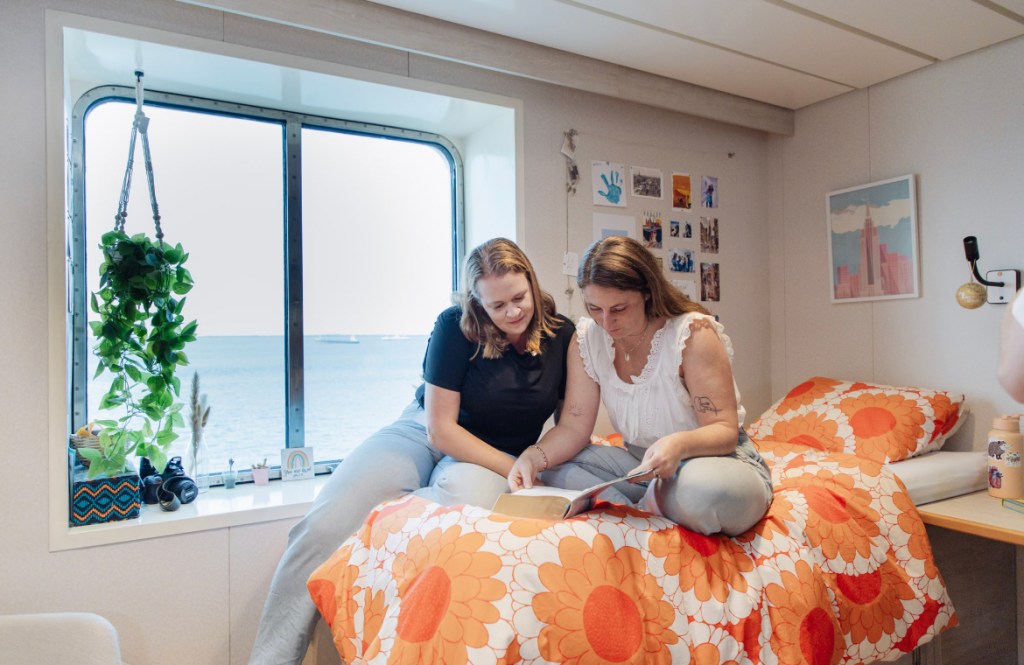
I will never forget the moment I got my first Bible, the excitement, the joy, the overwhelming sense that I was holding something sacred and life-changing in my hands. It felt heavy, not just in weight but in significance, as if the very pages contained something I had been searching for my entire life.
It was late at night in the dining room, long after most people had gone to bed. The air was still thick with the echoes of laughter, of conversations that had stretched for hours, unravelling thoughts and questions about God, about faith, about this strange and beautiful new path I was on. My heart was still buzzing from it all, from the kind of deep, soul-searching talks that leave you feeling both lighter and more awake than ever before. And then, in the midst of it, Shannon bought me a Bible. Not just any Bible, my first real Bible.
“My Big Girl Bible,” I had joked, a phrase we laughed about. It had started as a running joke because, up until that point, I had been reading The Jesus Storybook Bible, a children’s Bible. It was all I had known, and in some ways, it felt like the right place to start. No upbringing in the church, no background in Scripture, how else was I supposed to begin if not with something that broke it down in its simplest form? I would listen to children’s Bible stories on Spotify as well, sitting cross-legged on my bed or curled up in a quiet corner, notebook in hand, scribbling down a million and one questions as they flooded my mind. I wanted to understand everything. The stories, the meaning, the history, the why behind it all. I was hungry for knowledge in a way I had never been before, as if each verse, each parable, each passage held a key to something I had been searching for my whole life.
I remember when my Bible finally arrived in the mail running my fingers over the cover, feeling the weight of it, knowing it was more than just a book, it was a doorway. A new beginning. A tangible piece of the faith I was stepping into. Holding it, I felt like a child taking their first unsteady steps into something vast and unknown. But instead of feeling lost, I felt found.
I soaked up every story, every lesson, every word. It was like discovering a whole new world, one that had always existed, yet somehow felt as though it had been waiting for me all along. I couldn’t get enough. I had so much to learn. And I wanted to learn. I would sit in the dining room late at night, curled up in a lounge chair or tucked into bed, bombarding my friends with question after question. I wasn’t afraid to ask, wasn’t embarrassed by what I didn’t know, I was desperate to understand. And the beauty of it all? They didn’t always have the answers.
At first, that surprised me. Weren’t they supposed to know? Weren’t they the ones who had grown up in the faith, who had spent years reading the Bible, who should be able to explain everything with certainty? But instead of frustration, I found comfort in their honesty. They didn’t pretend to have it all figured out. They pondered, they debated, they admitted when they were unsure. And somehow, that made it all feel more real. Maybe we weren’t supposed to have all the answers. Maybe faith wasn’t about certainty, it was about trust. Maybe some things were meant to remain mysteries, known only to God. And maybe, just maybe, that was okay.
But it wasn’t always easy. In fact, some days, it felt nearly impossible. One of the hardest challenges I faced in the beginning was the sheer weight of how much I didn’t know. It was as if I had stepped into a world where everyone else spoke the language fluently, while I struggled just to understand the basics. I was surrounded by people who had been Christians their entire lives, people who could cite scripture effortlessly, who spoke in a rhythm of faith that felt foreign to me. They referenced Bible stories with ease, weaving verses into conversations as naturally as breathing. I, on the other hand, barely knew where Genesis ended and Exodus began. It was intimidating. Overwhelming.
I had never felt that gap more than I did at my first Bible study. I remember walking in, my heart pounding, my hands gripping the edges of my Bible as if it were an anchor. I sat down among them, my stomach twisting in knots, praying, begging, that no one would ask me a question. What if they expected me to contribute? What if they realized I had no idea what I was doing? I felt like an imposter, like at any moment someone would turn to me and ask, What do you think, Ayla? and I would have nothing to say.
The enemy saw my fear and seized it. The lies crept in, subtle at first, then deafening: You will never know enough.You don’t belong here.You are too far behind to ever catch up. They will see right through you. I wanted to disappear. I wanted to shrink into my chair and fade into the background, to find a way out before anyone could realize just how lost I felt. But I stayed. I swallowed my fear, fought back the doubts, and stayed. Because somewhere, buried beneath the fear, was the smallest flicker of hope, hope that maybe I did belong, even if I didn’t know all the answers. Hope that faith wasn’t about knowledge or expertise, but about the willingness to seek, to learn, to trust. I just didn’t know it yet.
Ironically, my first Bible study ended up being about the devil himself. It felt almost too fitting, given the battle raging inside of me, the lies whispering that I didn’t belong, the fear that I would never know enough, the overwhelming sense that I was in over my head. I sat there, barely breathing, listening as the group discussed spiritual warfare, the ways the enemy works to deceive, to discourage, to keep people from drawing closer to God. Well, that explains a lot, I thought to myself.
Looking back, I wouldn’t necessarily recommend diving into a discussion about the forces of darkness on day one. I mean, of all the topics in the Bible, we could have started with something comforting, grace, love, forgiveness. But no, I walked straight into a conversation about the reality of the enemy, about the ways he twists truth, sows doubt, and keeps people trapped in fear. And yet, somehow, I didn’t let it deter me. Something in me refused to give up, to let doubt take hold. I pushed through, even as the lies clawed at me, even as the fear tried to drown me out. Because deep down, beyond the intimidation, beyond the feeling of being unqualified and unworthy, I was beginning to know something. This journey wasn’t about having all the answers. It wasn’t about being able to quote scripture effortlessly or understanding every theological debate. It wasn’t about earning a place at the table or proving that I belonged. It was about knowing Him. And that was enough.
There have been many times over the past two years when I have felt like I would never know enough. Never be a good enough Christian. Never know enough Scripture to speak with confidence. Never pray the right way, with the right words, in the right rhythm that seemed to come so effortlessly to others. The doubt still creeps in sometimes, whispering that I am lacking, that I will never measure up. That I am still too new to this, too inexperienced, too far behind to ever catch up. I have sat with my Bible open in front of me, staring at the words, wondering how I would ever understand them fully. I have listened to others pray with such ease, while my own prayers felt clumsy, broken, incomplete.
But in the midst of it all, I have learned something invaluable. God does not love me for my knowledge. He does not measure my worth by how much Scripture I have memorized or how eloquently I can pray. He does not require perfection. He does not love me more when I understand and love me less when I struggle. I have learned that no one will ever know enough. It doesn’t matter if you’ve been a Christian for one day, two years, or your entire life, there will always be questions. There will always be moments of uncertainty, moments where faith feels like standing in the dark and choosing to trust anyway. We are all still learning. Every single one of us. And maybe we will never have all the answers. Maybe we were never meant to. Maybe faith was never about certainty, but about surrender.
And that’s okay. Because God knows. And in the end, that is enough.
Some people find that frustrating, the idea of surrendering control, of trusting without knowing every detail. They want certainty, a roadmap, a guarantee that every step they take will lead exactly where they intend to go. The thought of not knowing makes them uneasy, like walking a path shrouded in fog, unable to see more than a few steps ahead. They crave answers, structure, and assurances before they are willing to trust. And I understood that, because for so long, I had been the same way. But for me, surrender wasn’t frustration, it was freedom. For the first time in my life, I could finally breathe. I could finally let go. The weight I had been carrying, the pressure to figure it all out, to make sense of my past, to control my future, began to lift. I realized I didn’t need to know everything. I didn’t have to have all the answers.
Because God had a plan for me. A plan bigger, greater, and more beautiful than anything I could ever construct on my own. A plan I didn’t need to see in full to trust. And as long as I kept pursuing Him, seeking His wisdom, walking in faith, and surrendering my fears, then I would be okay. Maybe I wouldn’t always understand the why or the how. Maybe the road ahead wouldn’t always be clear. Maybe life would still bring unexpected storms. But I didn’t have to have it all figured out. Because He did
Proverbs 3:5-6 always comes to mind.
“Trust in the Lord with all your heart and lean not on your own understanding; in all your ways submit to Him, and He will make your paths straight.”
These words have become more than just a verse to me, they are a gentle yet firm reminder to surrender my heart at the Lord’s feet. To truly trust Him, not just in the easy moments, but in the ones where fear grips me, where uncertainty clouds my mind, where I feel like I need to take control. It’s a call to release, To let go of my worries, my anxieties, my need to have all the answers. To rest in His sovereignty, knowing that even when I can’t see the full picture, He is still at work. To lean into the strong, unwavering arms of a God who never wavers, never fails, never loses sight of me. Because how many times have I tried to rely on my own understanding, only to find myself lost, anxious, or exhausted? How many times have I thought I knew best, only to realize now that God’s plan was far greater than anything I could have orchestrated?
This verse is a reminder to me that faith isn’t about holding on, it’s about letting go. It tells me to stop gripping so tightly to my own wisdom, to stop striving in my own strength, and instead, allow Him to take the helm. To trust that when I submit to Him, not just in some ways, not just on some days, but always and in always, He will lead me exactly where I need to be. Even if I don’t understand it at the time.
And in that, I find peace. Not the kind of peace the world gives, fleeting and fragile, dependent on circumstances. But a deeper peace. A peace that comes from knowing that I am held, that I am led, that I am loved.

 AYLA IN AFRICA