Such a simple question. Such a small sentence. And yet sometimes it feels impossibly heavy.
My throat tightens. My mouth feels thick. The words sit there, but they won’t come out clean. What do I say?
“It was good.” “It was fine.” “It was okay.”
But that isn’t the truth.
I smile, but it doesn’t quite reach my eyes. Today it’s a practiced smile. Today my eyes look away first.
Because what would the truth sound like?
Today was bad. Today a baby nearly died because we didn’t have what we needed. Today we ran out of oxygen. Today a parent grabbed my arm and begged me to save their baby. Today I stood in a room where hope felt fragile and thin.
Today was hard.
But sometimes… that’s my day everyday.
So what do I say when you ask me how my day was?
I say, “It was fine.” I say, “It was okay.”
Because today I don’t have it in me to describe what I see. I don’t have the energy to unpack the weight of it. Sometimes I don’t want to be the heavy one in the room. Sometimes I don’t want to explain why my heart feels bruised.
And if I’m being honest, sometimes there’s a flicker of something else too. A quiet jealousy I don’t like admitting. You sing and dance and celebrate. You see the victories. And I stand in the suffering. I watch the endlessness of it. I hold the tension of it.
I don’t mean to feel that way. I know it isn’t the truth. I know those thoughts are whispers trying to distort perspective, trying to pull me into comparison instead of calling.
Because I also know this: I am not alone in it.
“I can do all things through Christ who strengthens me.” (Philippians 4:13)
Not because I am strong. Not because I don’t break. But because when I have nothing left, He is still steady.
And so sometimes, instead of pretending, instead of shrinking the truth to make it easier for everyone else, I pause.
I take a breath. I let the air fill my lungs slowly. I let my shoulders drop.
And I say, gently, honestly,
“Today was hard.”
Because that is the truth.
And somehow, in speaking it, I find a little more strength to keep going tomorrow
Every day is different. Some days, the beauty feels buried, hard to find beneath the weight of suffering. On those days, my eyes seem to catch only the pain, the loss, the unanswered prayers. And then there are other days, days when beauty insists on being seen. Days when God feels so close it’s as if He’s woven into the air itself.
The last few days have been like that. Full of quiet, holy moments. Moments where my body felt almost alive with the Spirit, like something inside me was humming, attuned to a deeper frequency. Over and over again, I could sense Him whispering:
I am here. I am everywhere.
Friday I walked onto the paediatric ward at Connaught, often one of the hardest wards I work on. A place where tiny bodies carry impossibly big burdens. A place where heartbreak sits side by side with hope. And yet, that morning, I could feel God already there, waiting.
When I arrived, one of my mentors was already on the ward, fully immersed in mentoring. And she was doing it beautifully. She was teaching and modelling patient-centred care, something that, in this environment, is not always prioritised or even possible.
In a system stretched thin by limited resources, overwhelming patient loads, and constant urgency, care often becomes task-focused out of necessity. You do what you can to survive the shift. You move fast. You attend to the most critical needs. There isn’t always space to slow down, to listen, to see the patient beyond the diagnosis.
So to walk in and witness patient-centred care unfolding in real time, to see a nurse pausing, explaining, involving caregivers, treating a child not as a task but as a person, felt like a massive win. A quiet miracle. Evidence that something is changing. That seeds planted through mentoring are beginning to grow.
And while, like most days, the ward was full of sick pikins, there was something different in the air. Maybe it was my perspective. Maybe it was grace. I’m not sure. But suddenly, I could see the beauty woven through the suffering.
Two young boys lay in beds next to each other, giggling and teasing one another, laughter bubbling up between IV lines and worn blankets. For a moment, they were just boys, playful, mischievous, alive.
I know we’re not supposed to have favourites, but there’s a little ten-month-old pikin on the ward with a massive abdominal mass, so large that every time I see him, it feels like it’s grown again. His tiny body dwarfed by something so unfair, so heavy. Every time I visit, I spend time with him. I play. I talk. I let him grab my fingers. His big, wide eyes always watch me carefully, curiously, trying to work out who this strange-looking person is.
On Friday though I was greeted with smiles. With trust. He reached for me and rested his head against my arm, completely at ease, staring up at me with a wide, contented grin. In that moment, the world felt still. Sacred.
I whispered, Thank you, God, for moments like this.
On the ship, the wards are often filled with music and dancing. Joy spills out easily there, life-changing surgeries, legs straightened, tumours removed, stories wrapped in celebration. That is not the reality of my work here at Connaught though.
But on Friday visitors from a local church came onto the ward. And we sang. One of my favourite songs, Tell Papa God Tenki. The caregivers sang. The nurses sang. The children listened. And together, in the middle of illness and uncertainty, we praised God.
The visitors handed out water and food. I watched gratitude soften the faces of weary mothers. I watched children’s eyes light up as they unwrapped their small treats, joy flickering where fear had lived moments before.
And once again, I felt it, that gentle, steady whisper: I am here. I am everywhere.
When I reflect on moments life this I find myself returning again and again to Psalm 139:11–12 “If I say, ‘Surely the darkness will hide me and the light become night around me,’ even the darkness will not be dark to you; the night will shine like the day, for darkness is as light to you.”
It speaks of a God who is present in every conceivable place and moment, so present that there is nowhere we can go to escape Him. Not the highest heights. Not the deepest depths. Not the furthest sea. And not even the paediatric ward at Connaught, where suffering feels thick in the air and questions have no easy answers.
There are days here when the darkness feels overwhelming. Days when the pain is loud and relentless, when tiny bodies are burdened with illnesses far too big for them, when mothers sit beside beds holding fear in their eyes, when hope feels fragile and thin. On those days, I find myself asking the same quiet, aching question: Where are you, God, in this? Where are you in the suffering that doesn’t make sense, in the stories that don’t resolve, in the places that feel forgotten?
But slowly, gently, I am learning to trust what my eyes don’t always see at first. That God has not gone anywhere. That His presence doesn’t disappear just because the light feels dim. That the darkness has no power to hide Him, no matter how heavy it feels.
I see Him in the nurse who pauses to practice patient-centred care in a system that rarely allows for it. I see Him in two boys giggling from their hospital beds, choosing laughter in the middle of illness. I see Him in a ten-month-old pikin resting his head against my arm, trusting without understanding why. I hear Him in songs sung softly on a ward that knows too much grief. I feel Him in the gratitude of mothers receiving food and water, in children unwrapping small gifts like they are treasures.
It is impossible to hide from Him, not because He is watching from a distance, but because He is already here. Holding. Seeing. Staying. God is in control, yes, but more than that, He is near. He is present in the shadows, quietly providing light even when I can’t yet see where it’s coming from.
Sometimes what I need most isn’t answers or explanations, but stillness. To stop. To breathe. To really look. Because when I do, when I listen instead of rushing past, I hear it again. That gentle, steady whisper beneath everything else, the same one that has followed me through these days:
I am here. I am everywhere.
And in that knowing, even the darkness begins to soften.
So many feelings, everywhere, all at once, swirling inside me like a storm I can’t outrun.
They rise and fall like waves: sadness, anger, frustration, helplessness. I feel them all, pressing, pulling, choking.
They settle in my stomach like stones, heavy and unmoving. I carry them with me through the hospital, behind my eyes, in my chest, in my prayers.
There are days when I wonder how my heart keeps beating under the weight of it all.
“Why, God?” I whisper. “Why?”
Some days I scream it inside myself so loudly I’m sure the whole ward can hear it echo.
“Have You forsaken this place? These people? These nurses? Us?”
Death is everywhere. Every day.
Too often it comes for the young. Too often it comes for those who could have been save.
If only we had what we needed. If only the oxygen tank wasn’t empty. If only there was a bed in the ICU. If only there were more nurses, more resources, more time. If only.
Today, the oxygen tank is empty again. His oxygen saturation is 60%. I know what that means. I know what’s coming. And I’m screaming inside.
He looks up at me, wide-eyed and gasping. A young man, just barely more than a boy.
His eyes plead, Save me.
I can see it in his gaze, feel it in the way his fingers grip my wrist, hear it in the sharp, broken inhale of his breath.
Please…save me.
And I want to.
God, how I want to.
But I know we won’t.
I know we can’t.
We don’t have what we need. Not today. Maybe not tomorrow. Maybe not ever.
And that truth slices through me in a way I can’t explain, like watching someone drown while your arms are tied to your sides.
The nurses move around me. I see the defeat in their eyes too. It’s familiar now. Worn in like old skin.
They look at me and say, “It’s not easy.”
And I nod, because what else can I say?
They’re right. It’s not easy. It’s never been easy. But some days—it feels impossible.
We do what we can. We try. We always try. We pray before procedures we know might not succeed. We stand at the beside of patients in respiratory distress, watching their oxygen saturations fall despite our best efforts. We hold hands that are burning with fever and shaking with sepsis. We watch as they take there final breaths.
And then we gather ourselves, step to the next bed, and start again.
Because we have to.
Sometimes I feel like I’m unraveling at the seams, grasping for faith, for hope, for some sort of answer to the chaos. But the truth is I don’t have one.
Not right now. Just questions. Just heartbreak. Just the raw, aching grief of knowing that someone’s son died today when he didn’t have to.
Maybe tomorrow will be better. Maybe we’ll have oxygen. Maybe the medicines will come. Maybe we’ll have just enough staff, just enough strength, just enough grace to get through another day.
But today, all I have is this. An empty tank. A heavy heart.
And a prayer spoken through tears that maybe, just maybe, God will meet me in the middle of this brokenness, and remind me why I’m still standing.
Because somehow, in all of it, I’m still here. And for now… that has to be enough.
As most of you know, I’m Ayla, and for the past two and a half years I’ve been volunteering as a Nurse with Mercy Ships. For most of my time with Mercy Ships, I was serving on board the ship in the hospital as a nurse and I truly loved it. There is something incredibly special about providing direct patient care, seeing lives changed through surgery, and being part of such a unique community.
But from the very first time I stepped on this ship, way back in April 2023 and I heard about our Education, Training, and Advocacy team (ETA) I knew that was where my heart was pulled. I’ve always been passionate about development work, about creating change that lasts long after we leave. The idea of equipping and empowering local healthcare professionals to lead in their own hospitals and communities resonated deeply with me.
In hindsight, I can see that it wasn’t just passion, it was God’s calling. He was planting a seed long before I realized what He was preparing me for.
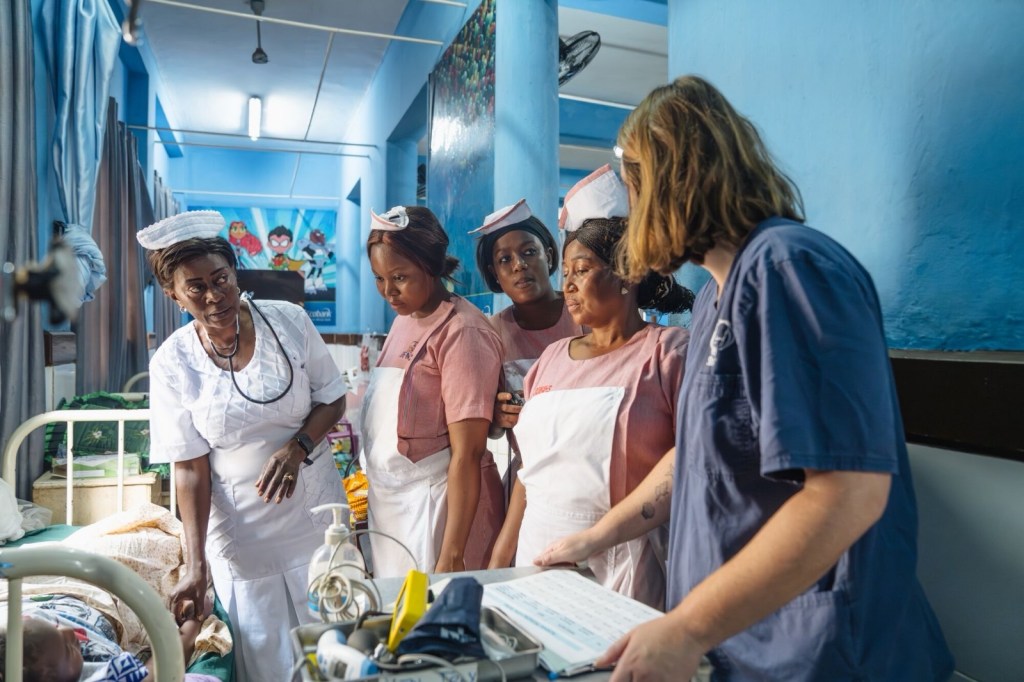
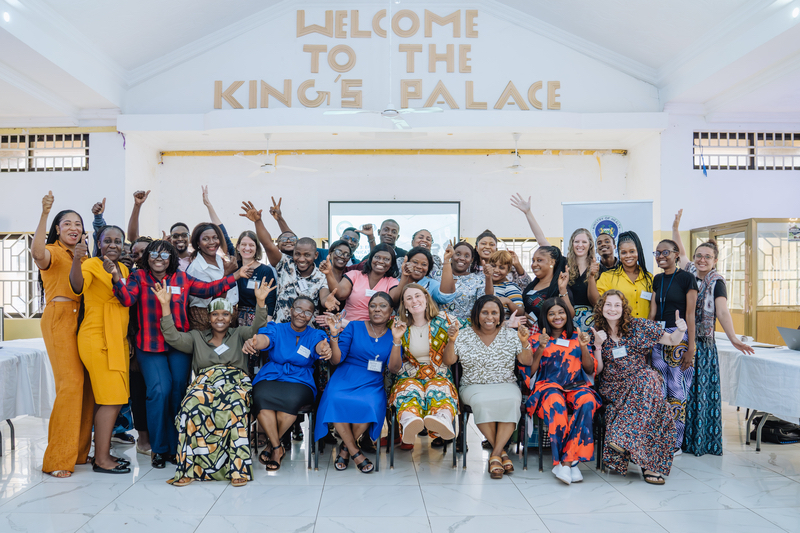
And then in January that dream became a reality and I stepped into a new role, working with ETA. This role now takes me off the ship and into Sierra Leone’s main teaching and referral hospital, Connaught, where I help run our Nurse Mentorship Program with my colleague and friend Katie.
I want to give you a glimpse into what it means to work alongside some of the most resourceful, resilient nurses I’ve ever met. You’ll hear about the realities of healthcare in Sierra Leone, not sugar-coated, but also not hopeless, because what I’ve seen here is not defined by limitations, but by possibility.
I want to share the vision and structure of our Nurse Mentorship Program, the changes we’re seeing, and the stories of nurses whose confidence, leadership, and clinical skills are growing every day. I’ll also share my own journey, how this work has challenged me, changed me, and deepened my belief that when you invest in people, transformation follows.
Context is Everything…
When I talk about Nurse Mentoring, I can’t just dive into what we do without first painting a picture of the place we do it in. it’s important to understand the setting in which it exists, because context changes everything. The needs here, the way care is delivered, and the way teams work together is different from what many of us have experienced elsewhere. And yet, that difference is also what makes the work so vital.
Sierra Leone is a country of about 8.4 million people, and its healthcare system is a patchwork of government-run hospitals, private clinics, and facilities supported by NGOs or faith-based organizations. The main referral and teaching hospital in the country is Connaught Hospital, right in the center of Freetown. It’s the place where patients with the most complex or urgent needs from all over the country are sent.
The history here has shaped the health system in profound ways. The civil war of the 1990s tore apart infrastructure and displaced countless healthcare workers. Then, just as the country was rebuilding, the Ebola outbreak hit. It not only claimed thousands of lives, but it took a heavy toll on the very people meant to protect public health, nurses, doctors, community health workers. And even today, the system continues to feel the ripple effects, shortages of trained staff, limited access to essential medicines, fragile supply chains.
To put into perspective staff shortages, I know some people love numbers. There is approximately 0.2 surgeons per 100,000people. In contrast, Australia where I am from has approximately 22 surgeons per 100,000, a ratio 110 times higher than Sierra Leone’s, highlighting an enormous disparity in surgical workforce capacity.
The Nurses
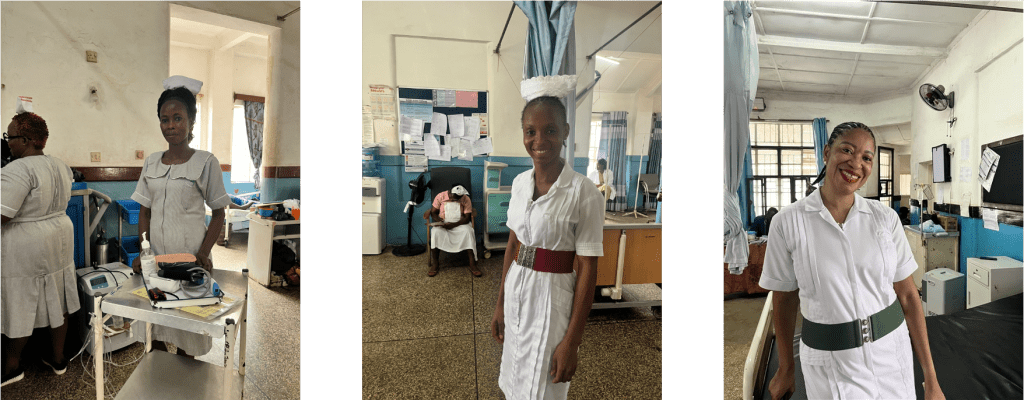
But I want to talk about the nurses because that’s who I train, mentor and work alongside every day. Nurses are the backbone of healthcare in Sierra Leone. They are the ones who keep the wards running day and night, often with little more than their own skill and determination. In Sierra Leone there are three main cadres of nurses.
First, there are the SECHNs, State Enrolled Community Health Nurses. This is a certificate-level course, and SECHNs form majority of the nursing workforce at Connaught Hospital. This course is no longer offered in Sierra Leone. The change I believe was part of a move towards higher levels of nursing education, with the aim of standardizing training and ensuring that all new nurses graduate with the skills and knowledge needed for increasingly complex healthcare environments.
While SECHNs are no longer being newly trained, those still working bring years, sometimes decades of experience. Today a lot of SECHNs are going back to school to upgrade their education which is exciting for the country.
Then there are the SRNs, State Registered Nurses, who have undergone longer training around 3 years – similar to a diploma for most of us back home.
Finally, there are the NO’s, Nursing Officers which is equivalent to a bachelor’s degree, however here in Sierra Leone the training is 5 years, NO’s often take on leadership and specialist roles. Each cadre has different levels of training and skills, and yet in practice, they work side by side, covering for one another in the same high-pressure environments. At Connaught on the wards I work at there is usually around 1 or 2 NOs per ward and then the rest of the nurses are either SRNs or SECHNs.
One of the realities that’s hard to grasp until you see it firsthand is that not every nurse in the hospital is actually being paid. There’s something here called the “pin code” system. In order to receive a government salary, a nurse must be “pin coded,” which is a formal registration and placement within the system. The process is long, bureaucratic, and there aren’t enough positions available. This means many nurses you see working long shifts in the wards are technically volunteers, they show up every day, care for their patients, and yet take home no salary. They do it because they feel a calling, because the need is great, and because they believe their work matters.
But for many, there is also no other choice, without a pin code, they cannot receive a salary, and the only way to be considered for one is to prove themselves through months, sometimes years, of consistent work. It’s a long wait, filled with uncertainty, yet they keep showing up. That level of dedication is hard to put into words. We are lucky at Connaught that most of the nurses have pin codes.
The challenges are real. Staffing is often stretched to the limit, there are days and nights when one or two nurses are responsible for a ward with dozens of post-operative patients, each needing careful monitoring. And even when the nurses have the knowledge and the will, the tools they need are often missing or not working.
In Sierra Leone, patients are required to purchase almost everything needed for their care, from medications and IV fluids to gloves, tubing, syringes, and dressings. If a patient cannot afford these items, the nurse simply does not have the resources to provide safe or timely care.
There have been countless emergency situations where myself and other nurses have had to beg nearby patients to allow us to use their supplies for someone in crisis. Imagine pleading with one patient’s family for permission to use their IV tubing or gloves just to stabilize another patient in the next bed. Or having to make the choice between which patient gets oxygen. These are impossible choices that no nurse should ever have to make.
On the wards where I work, there is usually only one set of vital signs equipment for the entire unit. Sometimes broken, missing, or simply without batteries, and when that happens, nurses are forced to delay or skip regular checks, relying instead on observation alone. It’s not unusual to see a nurse trying to find another ward willing to lend their machine, knowing that doing so leaves those other patients without monitoring.
Oxygen supply is another constant challenge. Cylinders run out mid-shift, and concentrators, when available, can break down without warning. In emergencies, the absence of reliable equipment can be devastating.
I’ll never forget one shift when a patient began deteriorating. We needed to ventilate them urgently, but the only ambu bag on the ward was broken, it literally had holes in it. We searched the cupboards, checked the trolleys, asked other wards, but every ambu bag we found was either missing parts, had holes in it or didn’t work properly.
To make it worse the oxygen tank had ran out of oxygen and we had no epinephrine. We did everything we could, but sometimes, despite every ounce of effort, we lose patients because the tools simply aren’t there. Those are the moments that stay with you. It’s not a lack of knowledge or willingness, it’s the heartbreak of knowing exactly what to do, but not having what you need to do it.
I’m sharing this with you not for sympathy or to make you feel bad but because these are the realities the nurses at Connaught work with every day, as part of the normal rhythm of their jobs. And yet, despite these constraints, they find ways to keep going, to care for patients, and to support one another.
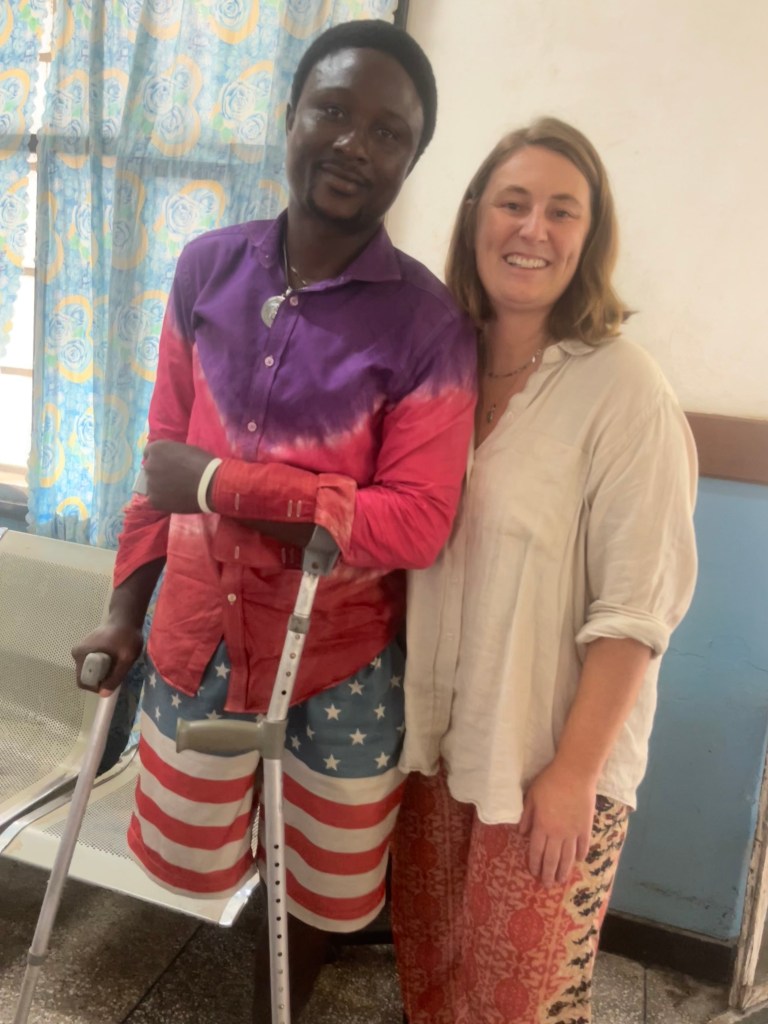
One story that has stayed with me, and that truly reflects the compassion and dedication of the nurses I work alongside, is that of a young man named Jose. Jose suffered from a chronic leg ulcer that required daily dressings and would eventually need a complex plastic surgery. His family, unable to afford the cost of his care, sadly abandoned him at the hospital. With no financial support, Jose was discharged and left to fend for himself.
Not long after one of the nurses found him outside the hospital, his wound badly infected. Refusing to turn their backs on him, the nurses brought Jose back to the ward. They pooled their own money to provide his food, cover the cost of his dressings, and tirelessly advocated for him to receive his surgery. Jose eventually received an amputation which although was not the original plan ended up saving his life. Jose remained on the ward for around 4 months before he was discharged recovered.
During that time, it felt like Jose became part of the ward family. Each day sitting outside the ward, he would read his Bible and greet Katie and me with the brightest smile. His resilience and faith left a deep mark on me, but even more so, it was the nurses’ unwavering care and selflessness that spoke volumes about the heart of nursing in such difficult circumstances.
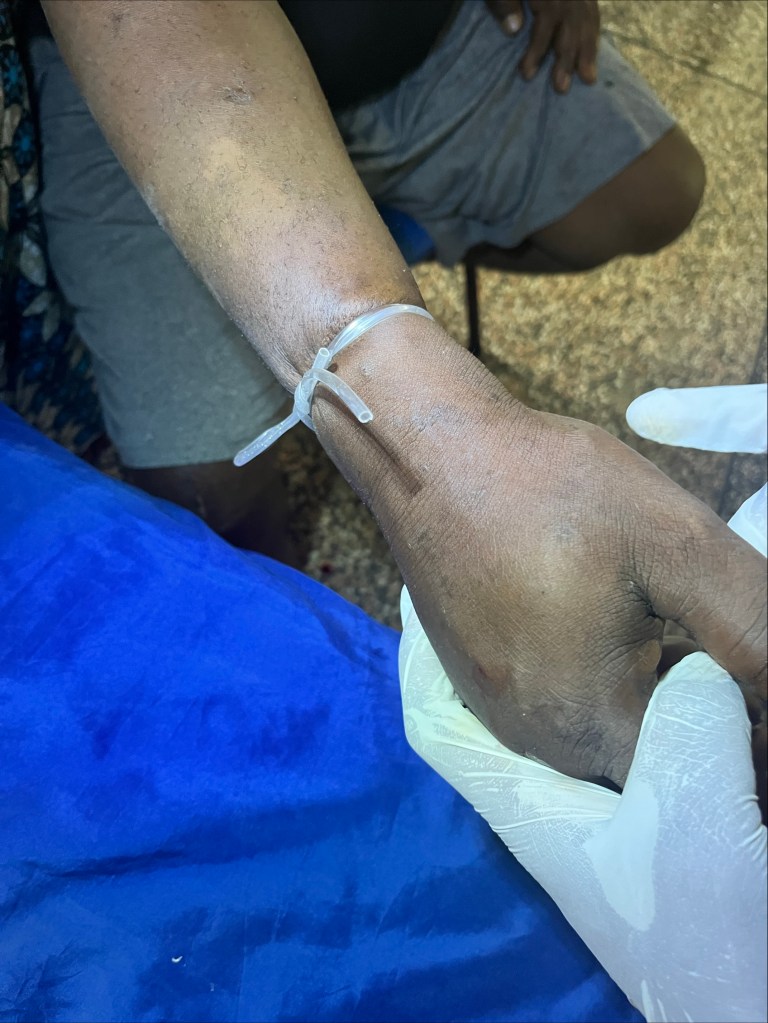
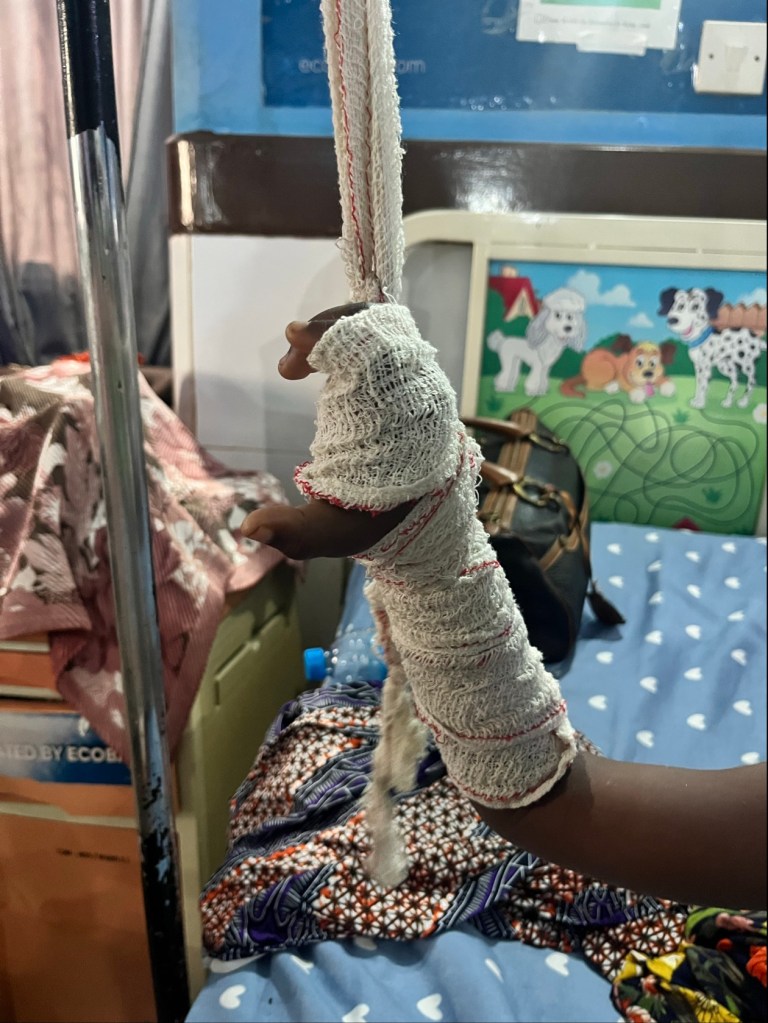
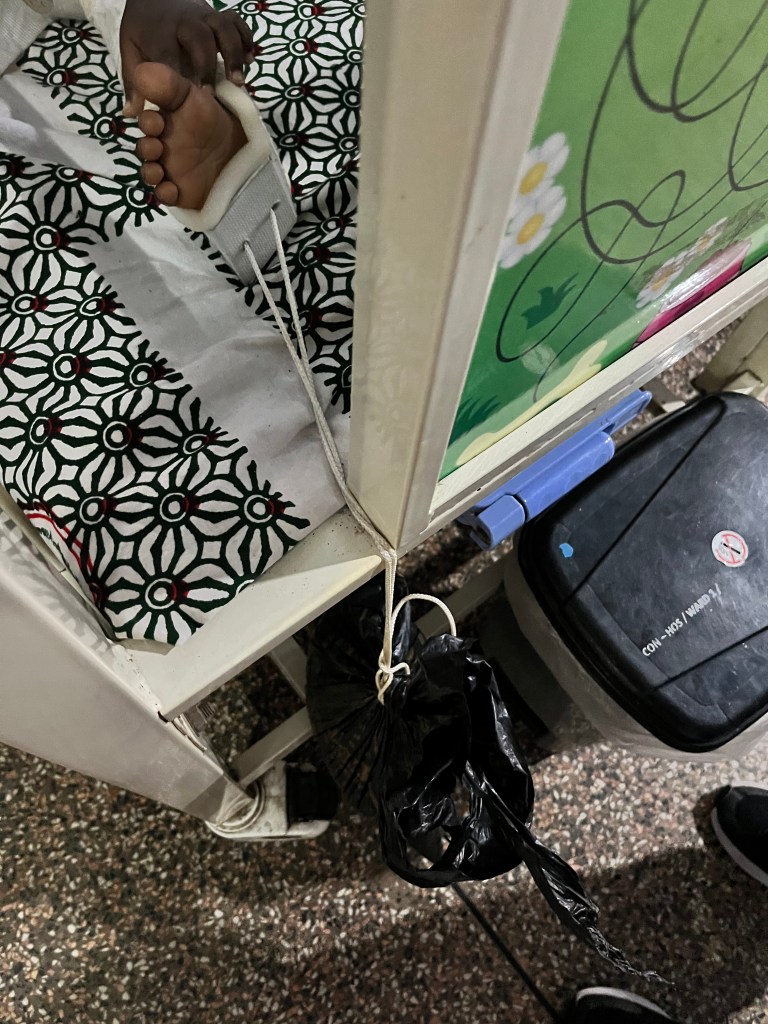
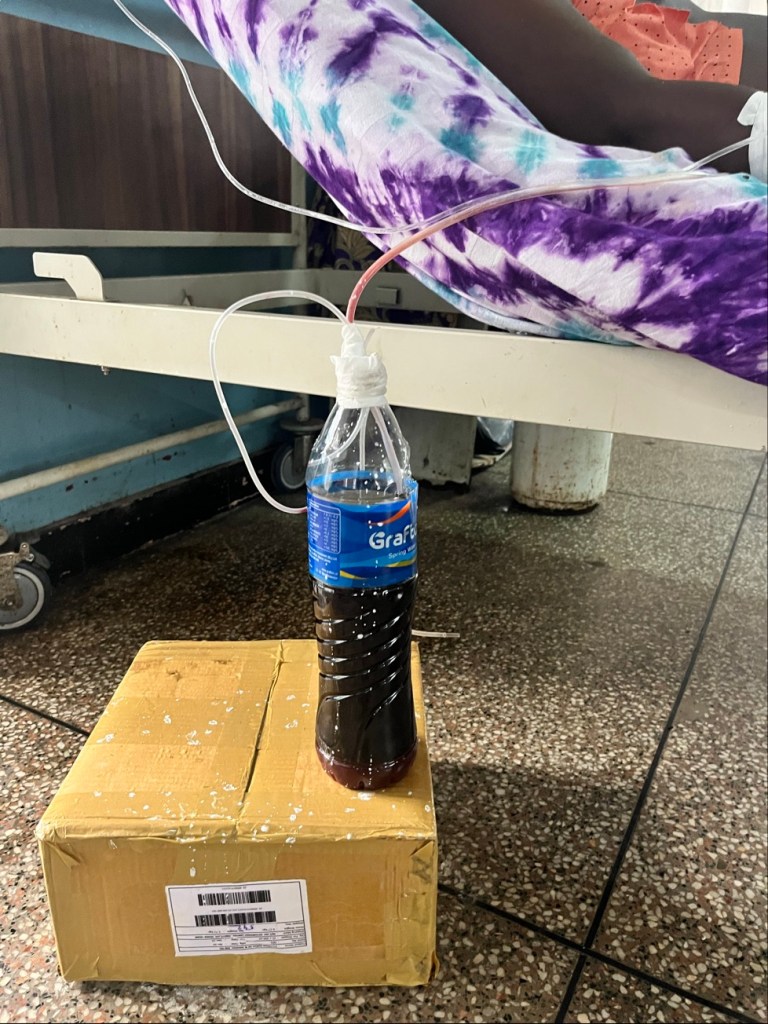
There is an extraordinary strength that runs through the nurses here. They are resourceful in ways that constantly amaze me. They think on their feet, they share what they have and they do their best to improvise solutions. Whether is making c-spine collars out of cardboard, DIY water seal chest tubes, torniquets out of old IV tubing or making home-made traction devices, I am constantly amazed by what I see and learn.
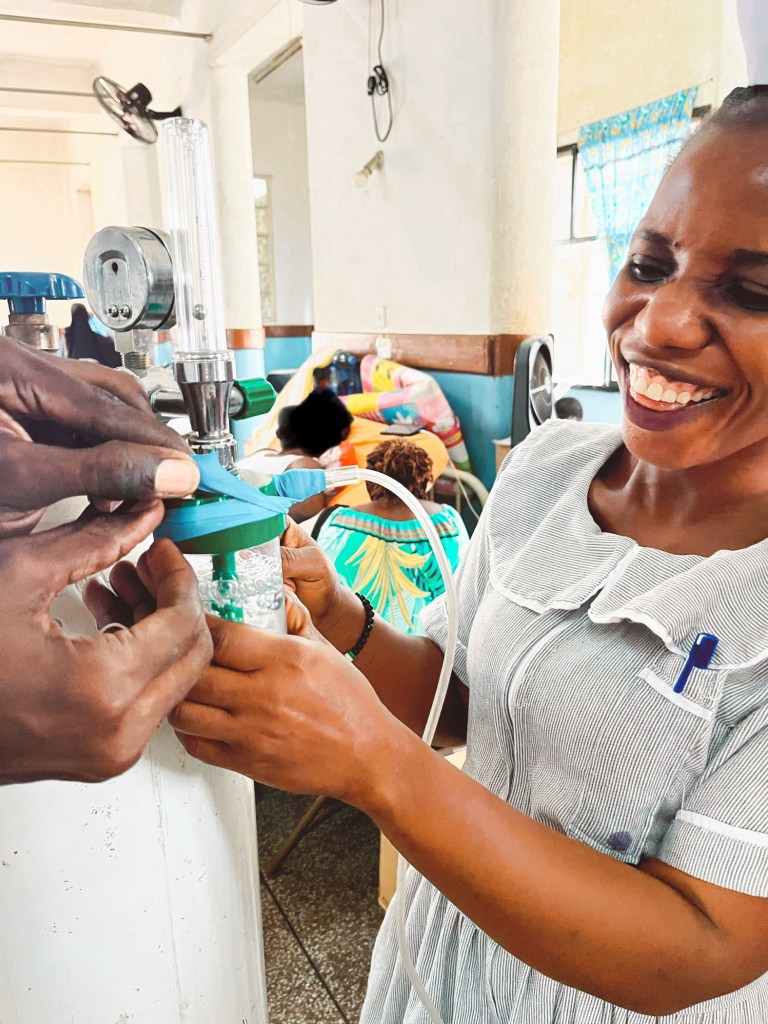
There was a day last field service when an oxygen tank on one of the wards broke during a critical moment. Back home in a hospital, you would simply switch to another oxygen bottle, or more likely, you’d have unlimited oxygen piped straight from the walls, a luxury we often take for granted. That is not the reality here at Connaught. Most wards only have two oxygen tanks and a lot of the time they are empty. But that day, the nurses didn’t waste a second. They pulled together, assessed the problem, and within minutes were using what they had, tape, tubing, and sheer determination, to make it work. And it did work. I remember standing there afterwards just marveling, not at the fix itself, but at the spirit behind it. I even took a photo of that moment, because it spoke so clearly about the heart of nursing in Sierra Leone: when the tools fail, the people don’t. They try with everything they’ve got.
Their resilience is born from living and working in a system that demands it. Many nurses grew up in the same communities they now serve. They know their patients not just as medical cases, but as neighbors, friends, even family. That connection drives them to keep going when the shifts are long and the resources are thin. And when training opportunities come along, they lean in with everything they’ve got.
This is the reality into which the Nurse Mentor Program steps. It’s why mentorship here is not just about teaching clinical skills, it’s about walking alongside nurses in their reality, helping them build confidence, leadership, and a vision for how they can influence care in their own hospitals. When you understand both the weight of the challenges and the depth of the strengths here, you start to see why this program has the potential to create change that will last for generations.
What is it We Actually Do?
So you’re probably wondering by now, what is it exactly that Katie and I do at Connaught Hospital. Together, we lead a Nurse Mentorship Program, which is part of the larger Safer Surgery Program. The heart of this program is simple but profound: every patient who comes for surgery at Connaught Hospital deserves safe, high-quality care, not just in the operating theatre, but before, during, and after their procedure. And to achieve that, it isn’t enough to provide surgery alone, we must also invest in the people who deliver the care every single day. That’s where the Nurse Mentorship Program comes in.
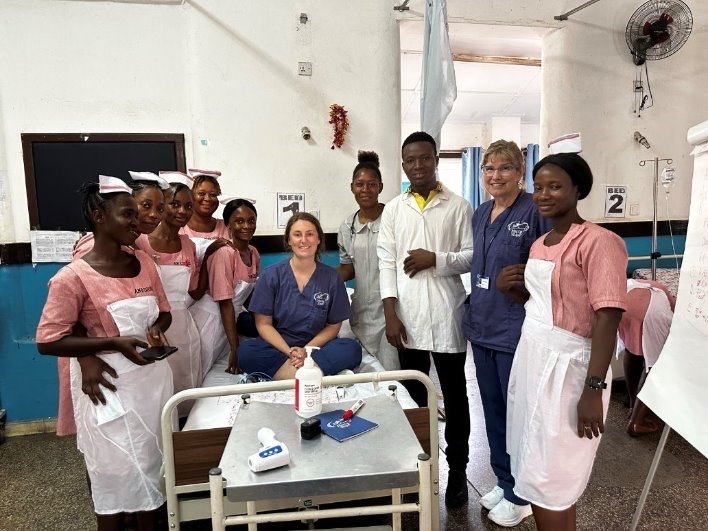
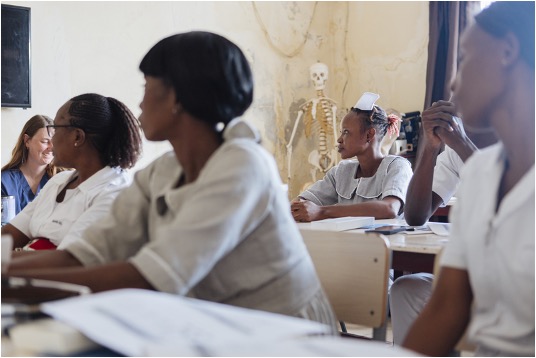
Our focus is on the surgical wards of Connaught Hospital, five wards in total: two male surgical wards, two female surgical ward and one pediatric surgical ward. These are busy, high-pressure environments where the needs are great and the staff-to-patient ratio is often overwhelming. Katie and I come alongside the nurses in these wards every day, not as outsiders swooping in to “teach,” but as colleagues working shoulder to shoulder. Our role is to mentor, to guide, and to support them in the delivery of surgical nursing care.
The first year of the Nurse Mentor Program was really about building trust. Before the nurse mentor program even began and before I joined Katie, she spent a lot of time at Connaught doing just that, building relationships. Walking into a hospital where resources are limited and the workload is immense, she knew she couldn’t just arrive with her own ideas and expect people to listen. So much of our early days were about forming relationships, listening, learning how the wards functioned, understanding the rhythms of care, and showing up consistently so the nurses knew we weren’t there to judge, but to walk with them. Trust doesn’t come quickly in a place where people are used to being overlooked or under-supported, but over time, by being present day after day, it grew. And once the trust was there, real mentorship could begin.
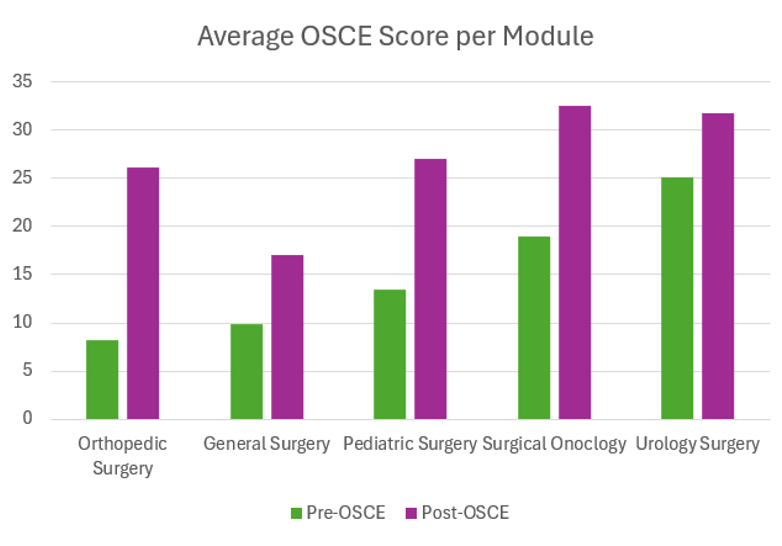
Over the course of that first year, we trained a total of 45 nurses across the five surgical wards. We created eight training modules, each one based around the surgical specialties that Connaught Hospital provides. Within those modules we also focused on basics like patient assessment, post op monitoring, pain assessment, IPC and documentation. These modules weren’t just designed in a classroom, they were built in real time, shaped by the realities we saw unfolding on the wards each day. Each module lasted about four weeks, with small groups of six to ten nurses at a time.
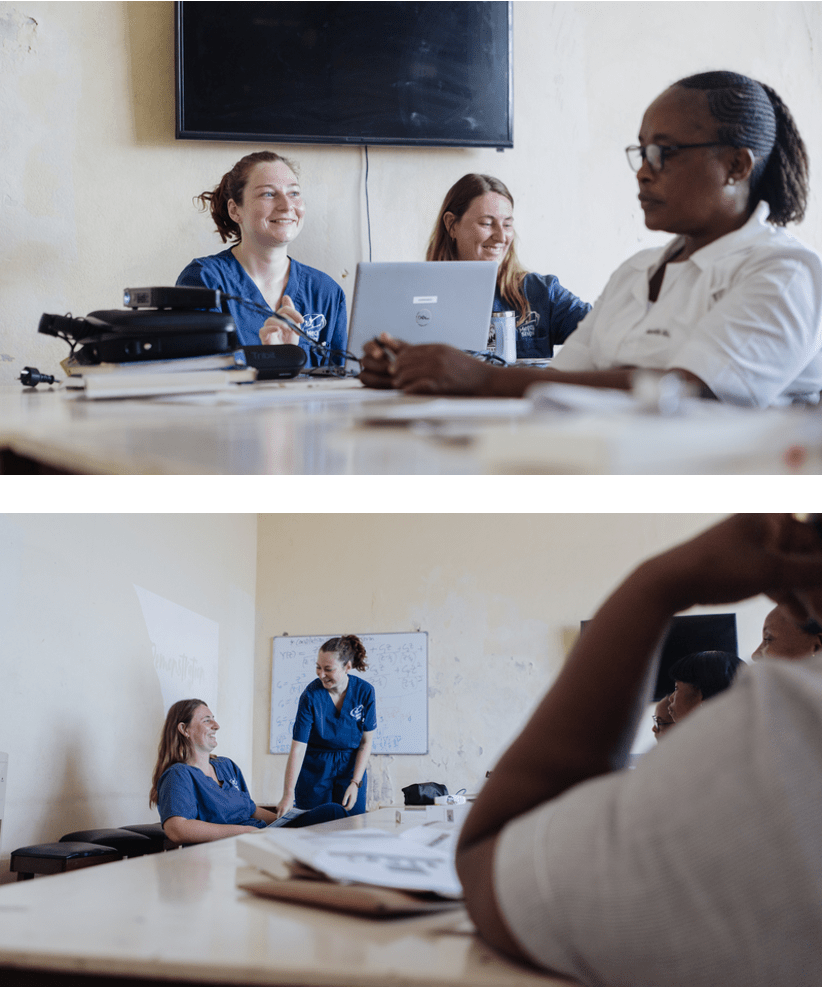
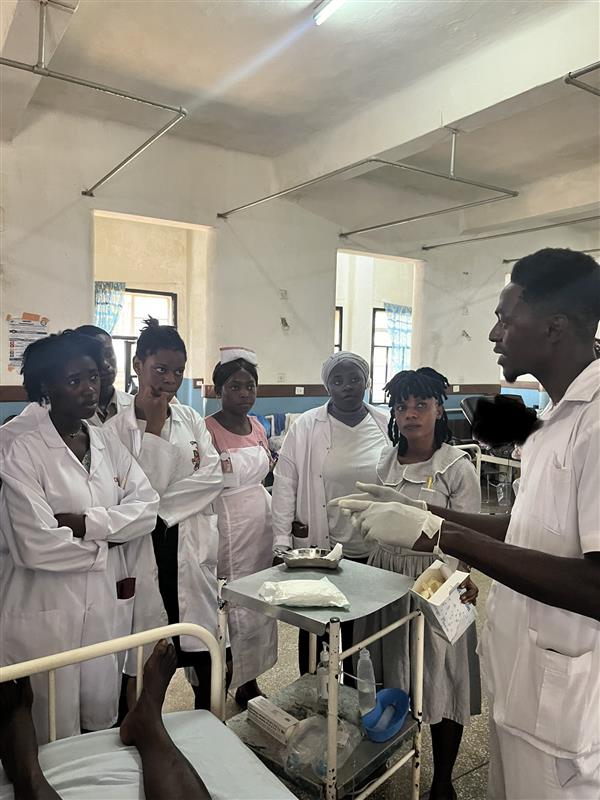
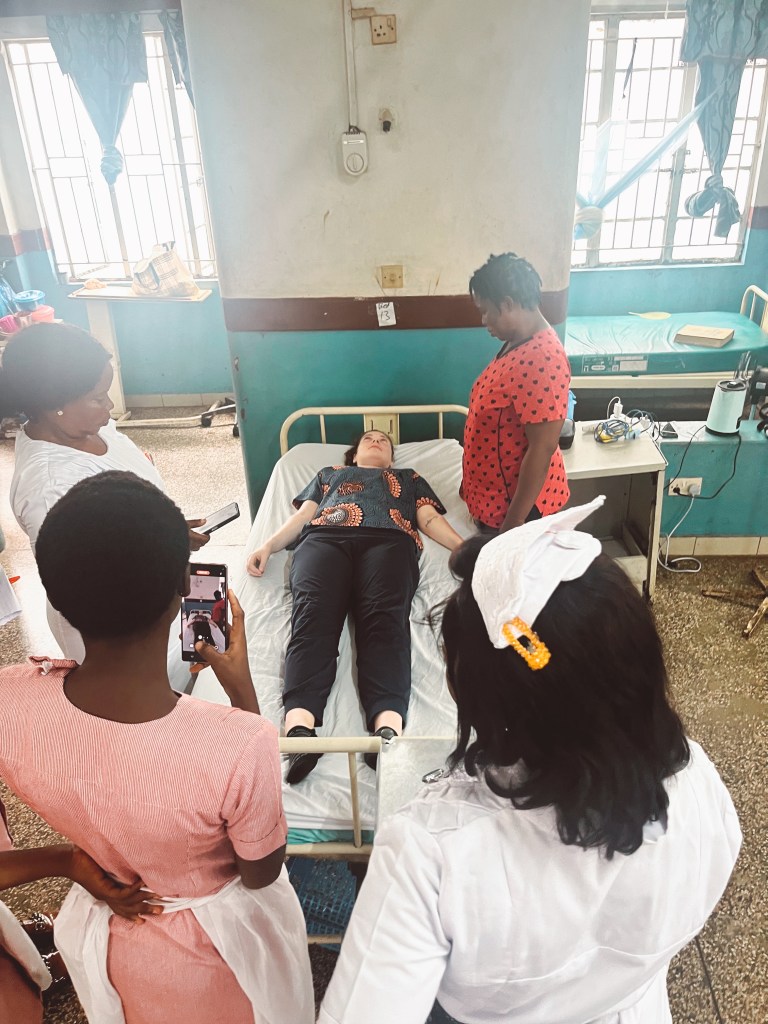
Mentorship in practice took many forms including class-room based learning, simulation, 1:1 hands-on mentoring, which made up the largest part of the program and some on ship mentoring. Some days it meant working alongside a nurse at the bedside, talking through an A–E assessment, helping them interpret vital signs, or guiding them through wound care. Other days it was about running simulation scenarios, which the nurses absolutely loved. Simulation gave them the chance to practice critical skills in a safe, controlled environment, without the pressure of a real patient’s life hanging in the balance. You could see their confidence grow as they worked through the scenarios, repeating them, laughing at their mistakes, learning from each other. It became a highlight of the program, because it created a space where learning felt alive and safe.
There were also theory days, where we’d step back from the wards to consolidate knowledge, and structured clinical assessments where nurses could demonstrate new skills and see their own progress. And of course, there was a lot of bedside teaching, those one-on-one moments where a mentor and mentee stand together at a patient’s side, and something just “clicks.”
But not every day looked like a lesson plan. There were days we walked into the wards and found them so full, so busy, that there was no space for formal teaching. On those days, we simply put on our hypothetical gloves, rolled up our sleeves, and worked as nurses. The most powerful mentorship isn’t about standing back and instructing, it’s about being right there in the middle of chaos, showing by example what compassionate, safe care looks like.
That first year taught us so much. It showed us not only the challenges of surgical nursing in Sierra Leone, but also the hunger for growth, the openness to learning, and the deep resilience of the nurses we walked alongside.
Time to Pause…
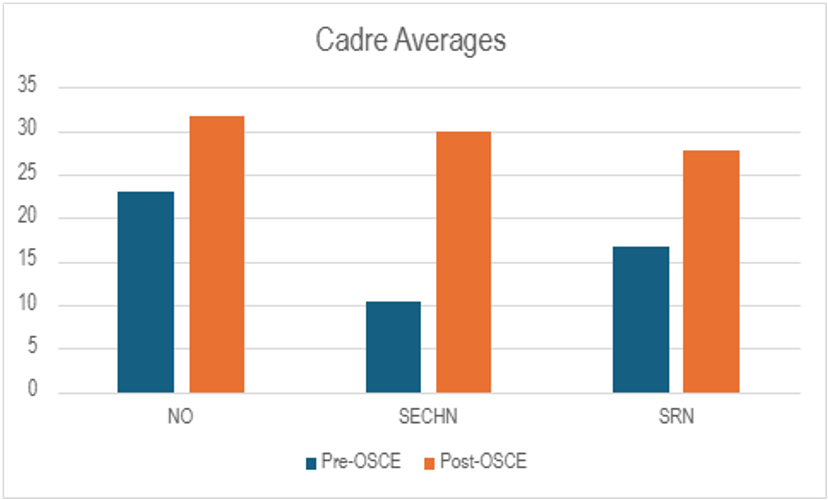
After one year of mentoring, it was time to take a pause, evaluate what we had learnt and the impact of what we had been doing. Now Year One of the Nurse Mentor Program was not without its challenges. From the very beginning, we realized just how wide the variation in skill levels was among the nurses. Some had strong foundations ( the NOs), while others were still grappling with the most basic principles of surgical nursing (SECHNs).
Designing content that engaged and supported everyone at once was not always easy. On top of that, staffing shortages at Connaught meant that nurses were often pulled in multiple directions. Many were also enrolled in university courses, which meant attendance at mentorship sessions could be low or inconsistent. And because this was a pilot initiative, there was no existing structure, no policy framework, no long-term plan for mentorship in place. We were learning as we went, building something new
And yet, despite the very real challenges of that first year, the achievements were remarkable. One of the reasons we saw progress was because the program itself was adaptable and flexible. We refined it continuously, responding to the realities of the wards and the feedback of the nurses themselves. We introduced skills assessments and logbooks so that progress could be tracked in a meaningful way.
We separated knowledge tests into general surgical care and specialty-specific knowledge, which allowed nurses to engage with material that was directly relevant to their work. And we even adapted classroom sessions, enabling more interaction, better engagement, and helping us overcome the constant staffing pressures that so often pulled nurses away.
We also saw change in the way nurses interacted with their patients. Especially those who had on-ship placements and were mentored in a different clinical environment came back with a new energy and a deeper sense of how compassionate communication can transform care. That in turn spread across the wards, lifting the overall culture of nurse-patient relationships.
Some feedback we received from nurses included: “I learned a lot about patient communication,” “I will continue to practice every day to maintain the process for the benefit of the patient” “I strongly believe that the knowledge and skills that I learnt through this mentorship will change my practice”
And the results spoke for themselves. One of the ways Me and Katie assessed our nurses skills was through an A to E assessment OSCE. We assessed their baseline before mentoring and then again at the end. Before the mentoring, only 16% of nurses passed their A to E assessment; after mentoring with me and Katie, 76% passed, a transformation not just in skill, but in self-belief. Nurses themselves described the change: One nurse said “It prepared me to deliver with confidence and honor.”
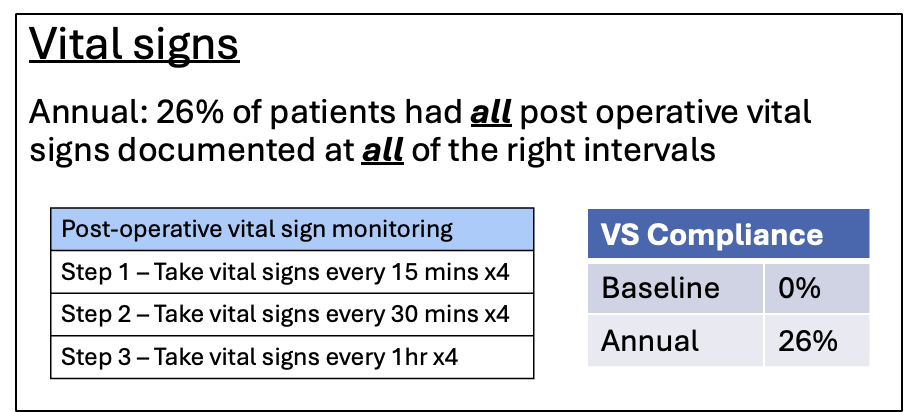
For me though I think one of the most powerful achievements came in the area of post-operative vital signs. Now for anyone that doesn’t know how often we as nurses have to take post op vitals signs its usually around every 15 mins x 4 for 1 hour, every 30 mins x 4 for 2 hours, every 1 hour x 4 for 4 hours, and then every 4 hours x 4. That’s a total of 16 sets of vitals.
When we first looked at how often vital signs were taken in the first 12 hours after surgery at Connaught, almost every patient—94% of patients—were only having their vital signs checked between zero and four times. That’s not enough for safe post-operative care. As you can see on the graph only a tiny 6% were getting them checked five to nine times, and no patients were reaching the recommended post operative vital signs monitoring. This translates to 0% of patients received post operative vital signs at the correct intervals.
Honestly, we had no idea what to expect when we did our annual data collection. But by the end of the year, 26% of patients had all post operative vital signs documented at all of the right intervals. Now, 26% might not sound impressive at first glance, but in this context, it is groundbreaking. It means that over a quarter of patients who previously would not have been monitored properly were now being assessed consistently, giving nurses the chance to catch deterioration earlier and intervene faster. In a setting where resources are limited, this improvement is a massive step forward, and it represents real lives saved. On top of that our data showed that 59% of patients were receiving vitals 10 or more times in the first 12 hours. That’s nearly a full set and a massive improvement from 0%.
So What’s Next ?
I think Year 1 showed us that when you invest in nurses, when you mentor them, and when you believe in their ability to grow, they rise to the challenge. Now, as we move into Year 2, we are building on that foundation. One of the big lessons we learned last year is that while external mentors like myself and Katie play an important role, true sustainability comes when mentorship is driven from within.
At the end of last field service in partnership with Connaught Hospital we formed a working group which comprised of Connaught Leadership, The Senior Matrons, the In-charges of the surgical wards and the Training Coordinators. We began meeting on a monthly, sometimes weekly basis to develop Year 2 of the program together. This allowed us to create a program that was locally driven and imbedded within Connaught Hospital.
So this year, we have shifted to a ward-based continuous mentorship model. We will be training 20 State Registered Nurses and Nursing Officers from the surgical wards to become clinical mentors themselves. The program adopts a strategy similar to a “Training of Trainers” approach but instead focuses on mentoring the mentors. These mentors are being equipped not only with advanced clinical knowledge, but also with skills in adult learning, bedside teaching, and giving feedback.
After an intensive five-day training back in October, the mentors returned to their wards and with the support of Katie and I, they began mentoring their colleagues as part of daily patient care. Each day we come alongside them and provide support in their mentoring whether that be a teaching session, simulation or 1:1 mentoring with their mentee.
The idea is simple: learning doesn’t happen in isolation; it happens right at the bedside. A nurse checks a wound, and her mentor is there to guide, ask questions, and model best practice. A post-operative patient needs urgent monitoring, and the mentor can coach the team in real time. Every interaction becomes a learning opportunity. And we aren’t pulling nurses away from the ward.
Each month, we introduce a new clinical topic, ten in total across the year. These topics were identified and chosen by the nurses at Connaught. We started with the basics like vital signs, A–E assessment, and documentation, and then move into more complex areas like post-operative complications, sepsis management, wound care. At the end of each topic, mentors receive certificates of completion, and when all ten are finished, we’ll celebrate together with a graduation.
This program is practical, locally driven, and designed in partnership with Connaught’s own educators and leaders. Our goal is not just to improve clinical skills, but to foster a culture of safety, teamwork, and professional growth. And we’re already seeing the excitement among the nurses stepping into these mentor roles. One of them told me, “I want to be the nurse who teaches the next nurses.” That’s the ripple effect we are aiming for.
This year is about sustainability. It’s about Connaught Hospital taking the lead with Mercy Ships standing alongside as a partner. It’s about shifting from training for the nurses, to training with the nurses, and ultimately, to them training each other.
I believe this is where the real transformation happens, not just in improved patient outcomes, but in nurses recognizing themselves as leaders, educators, and change-makers. That is the heartbeat of the Nurse Mentor Program.
What a Journey…
When I think back over the last year of working with ETA, I realize this work has taken me on an emotional journey I never could have anticipated. There have been moments of deep frustration, standing at a bedside knowing exactly what to do, but not having the tools to do it. Times when I’ve come home from Connaught with tears in my eyes, carrying the weight of patients lost, not because the nurses didn’t care or didn’t know what to do, but because oxygen ran out or equipment failed. Those moments have tested me, and at times they’ve left me asking hard questions about what “justice” in healthcare really means.
And yet, woven into that frustration has been joy, pure unfiltered joy. Joy in watching a nurse who once doubted her own ability confidently teach her colleagues. Joy in seeing a patient smile after weeks of suffering. Joy in the laughter that bubbles up in the middle of a chaotic ward when a teaching moment suddenly “clicks.” It’s in those small, ordinary victories that hope feels alive.
This journey has changed me. I came here thinking I would be the one teaching, but I’ve learned just as much, if not more from the nurses I walk alongside. They’ve taught me resilience that doesn’t quit, faith that holds steady when resources run dry, and a way of leading that isn’t about position or title but about presence, sacrifice, and community. It’s reshaped my view of global health not as outsiders bringing solutions, but as partners learning and building together.
It has also transformed the way I see nursing itself. Back home, nursing often looks like skill and knowledge wrapped in professionalism. Here, I’ve seen that at its core, nursing is about courage, the courage to keep showing up even when you aren’t paid, the courage to improvise when the tools are missing, the courage to fight for a patient who has no one else to fight for them. That kind of courage is contagious, it challenges me daily to be braver, to trust more, and to lead with humility.
There are still days when doubt creeps in, when the need feels overwhelming and progress too slow. But then I remember the faces, the nurses stepping up as mentors, the patients whose stories remind me why we do this, the glimpses of transformation that prove change is possible. And it’s in those moments that I feel proud—not of myself, but of the nurses of Sierra Leone, who embody every day what it means to be strong, compassionate, and unshakably committed.
That’s the heartbeat behind our work, and that’s why I believe in this program so deeply. Because in the end, this isn’t just about training or data points, it’s about people. It’s about choosing to hope, to invest, and to believe that even in the hardest places, light can break through.
Final Thoughts
As I close, I want to leave you with just a few final thoughts. If you take nothing else away from what I’ve shared, let it be this: investing in people changes everything. Buildings, equipment, programs, even ships may come and go, but when you equip someone with knowledge, confidence, and vision, that impact ripples outward, for patients, for families, for communities, and for an entire nation. And it lasts long after we leave.
Jesus said in John 15:16, “You did not choose me, but I chose you and appointed you so that you might go and bear fruit – fruit that will last.”
That’s what this work is all about. It’s about bearing fruit that endures – through lives transformed, through nurses empowered, through hope restored in places that once felt forgotten. That is the heartbeat of ETA: to plant seeds of change that will keep growing long after our season here is done.
Today, I received a gift that humbled me in a way I can barely describe. There are moments in life that stop you completely, moments that make you pause, breathe deeply, and feel the presence of God so powerfully that words fall short. Today was one of those moments.
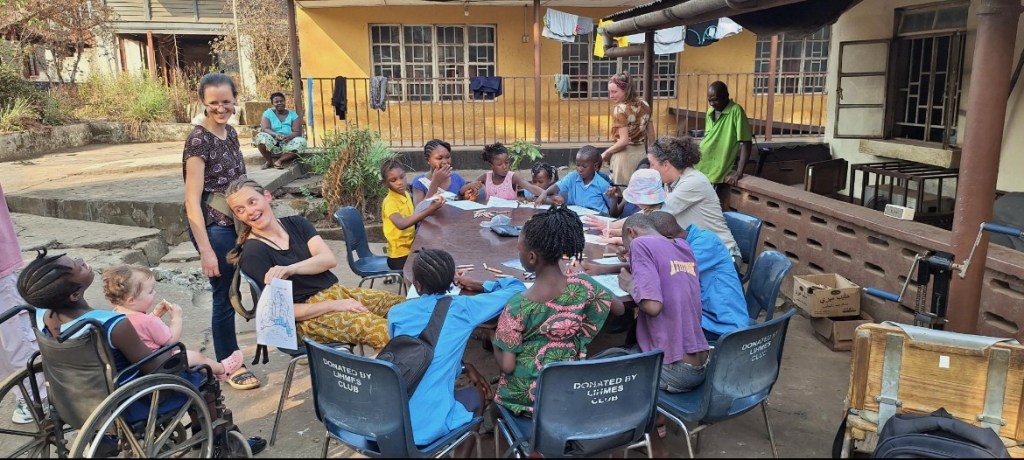
For the past two years, my Monday afternoons have been spent at Cheshire Home, a small school and orphanage for children living with disabilities. Those visits quickly became one of my favourite parts of the week. Every Monday, I’d walk through the gates and be greeted by a wave of laughter, music, and little arms reaching for hugs. We would spend the afternoon together, singing, dancing, telling Bible stories, and simply being present. No agenda. No rush. Just love, God’s love, poured out in the simplest of ways.
In Sierra Leone, disability is often misunderstood. It’s seen by some as a weakness, or, in the most heartbreaking cases, as a curse. Many families, already burdened by poverty and daily survival, are unable to care for their children physically or financially. Some are abandoned. Some are sent away. It’s a painful truth that cuts deep every time I think about it.
And yet, inside the walls of Cheshire Home, you find something extraordinary. You find joy. You find laughter. You find resilience wrapped in tiny hands and bright eyes that radiate hope.
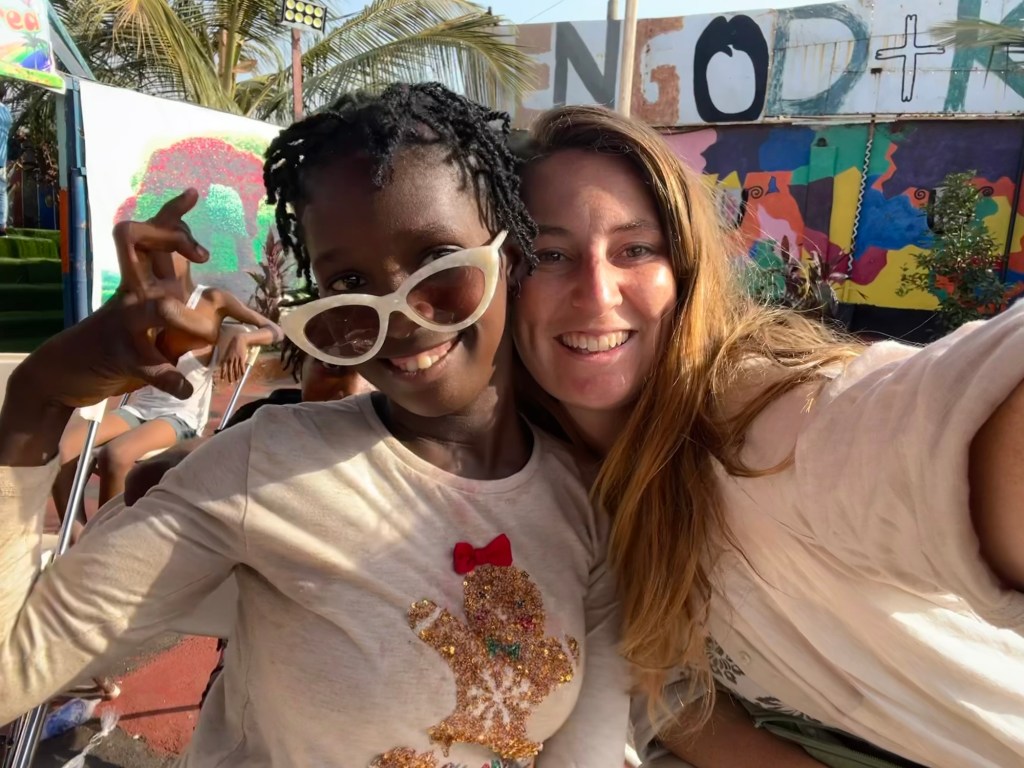
Among these beautiful souls is a little girl who has captured my heart, Jane Cheshire. Jane was born with cerebral palsy, a lifelong disorder that affects her movement, balance, and posture due to damage in the developing brain. It’s a condition that doesn’t just touch one part of life; it reshapes every part of it. For Jane, even the simplest tasks that most of us take for granted, like eating, drinking, dressing, or walking, require help. Her muscles don’t obey her mind the way she wishes they would. They stiffen and tremble, turning ordinary movement into an exhausting battle.
While her spirit is bright, her body often refuses to cooperate. Cerebral palsy has confined Jane to a wheelchair for life. She cannot stand or take a single step without support. Every transfer, every meal, every moment of daily living depends on the loving hands of someone else.
Jane was abandoned as a baby, but Cheshire Home became her family. They gave her their name and, more importantly, gave her love. Despite everything she faces, Jane is light. She radiates a joy that can only come from a place deeply touched by God.
Since beginning my new role off-ship, I haven’t been able to visit as often as I’d like. But every time I return, Jane’s face lights up the moment she sees me. She throws herself out of her wheelchair, arms wide open, laughing as she pulls me into a hug that could melt the hardest of hearts. Those moments remind me what pure, unconditional love looks like.
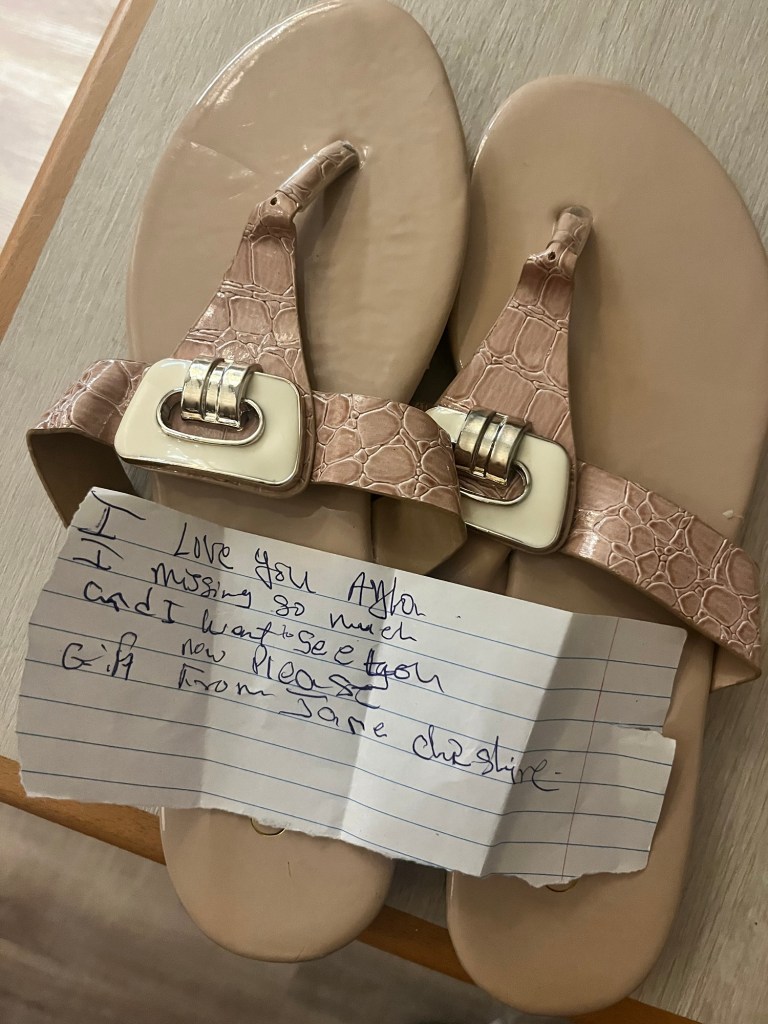
Today was another Monday I wasn’t able to visit Cheshire or Jane and after a long day, one of those days where anxiety had crept in, where I felt small and overwhelmed, I came back to my room and found a gift waiting for me. A small package sat by my door. I opened it, and inside was a pair of sandals, carefully wrapped, with a handwritten note:
“I love you Ayla. I missing you so much and I want to see you now. Gift from Jane Cheshire.”
The moment I read her words, tears poured down my face. I sat there, holding those sandals, completely undone.
Jane, a child who has been given so little by the world, a child who cannot talk or walk, who has no parents, who depends on others for her every need, gave me a gift. A gift that, to her, was something precious. She gave me shoes even though her shoes have holes.
She gave me love.
Those sandals are more than just shoes. They are shoes of love, a sacred reminder of what it means to give from the heart. They are a sermon without words, a testimony of God’s grace spoken through the hands of a little girl who has every reason to withhold but instead chooses to give.
As I held them, I thought about Jesus washing the feet of His disciples, an act of humility and love so deep that it transcends logic. Jane’s gift felt like that. A holy moment. God’s love, tangible and present, shining through the most unexpected place.
In a world that so often values what is big and impressive, Jane reminded me of what truly matters, a heart that gives freely, even when it has nothing left to give.
These shoes will never be just shoes. They are a symbol of grace, humility, and the kind of love that reflects the very heart of God.
Even in the hardest and darkest places, there is beauty. There is kindness. There is hope. And sometimes, it comes in the form of a pair of sandals from a little girl named Jane.
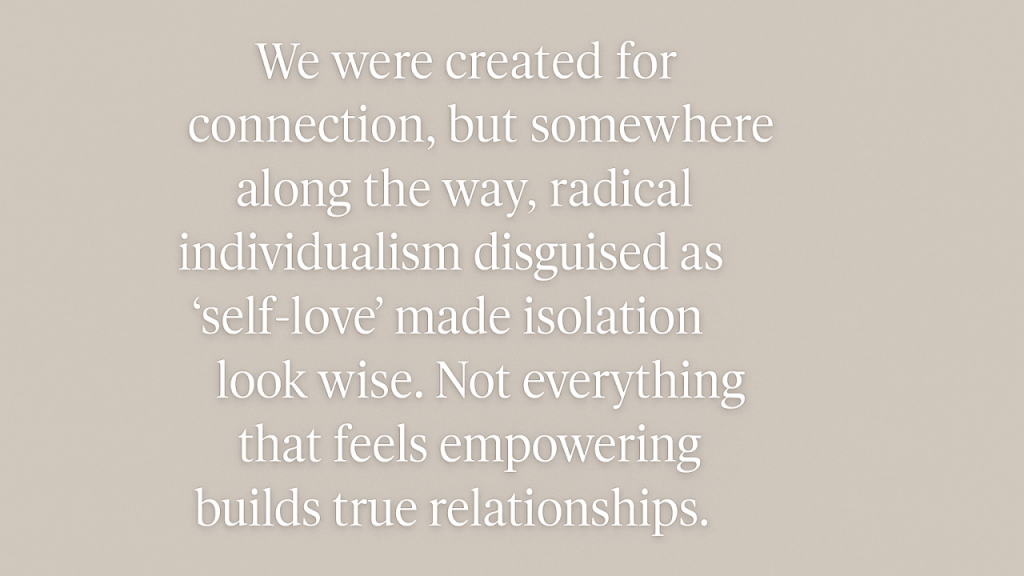
I came across this term recently, Radical Individualism, in my small group. At first, it was a phrase that felt foreign, like a sociological idea I’d never really thought about before. But the more I sat with it, the more I realized how deeply familiar it actually was. Because, in truth, it’s become the very air we breathe in modern society.
For much of my life, I wore independence like a badge of honor. I prided myself on being able to do everything on my own, convincing myself that needing others was weakness. I thought self-reliance meant strength. And while there is value in resilience, in determination, I’ve come to see how this mindset can also become destructive, both to ourselves and to the world around us.
Society celebrates the lone achiever, the “self-made” success story, the person who “needs no one.” We are told over and over that freedom is found in doing it all ourselves, carving our own path, and putting ourselves first. But if that’s true, then why are we living in one of the loneliest generations in history? Why are depression, anxiety, and suicide rates higher than ever before, especially in the very places where people have more material wealth, comfort, and opportunity than almost any other time in human history?
I think it comes down to radical individualism.
So what is it? Radical individualism is the belief that the highest good is personal autonomy, that the most important thing in life is the self: my rights, my choices, my freedom, my success, my happiness. It’s the airbrushed motto of our time: “Do you. Look out for number one. Live your truth.” It tells us that the self is ultimate, and that community, tradition, or collective responsibility come second, if at all.
We see it every day.
We see it in the way people are glued to their phones while sitting in a café surrounded by strangers they never acknowledge. We see it in the endless pursuit of “financial freedom,” as if reaching a certain salary could somehow fulfil us.
We see it in the curated lives plastered across social media, the new car, the kitchen renovation, the big house, the promotion, the holiday abroad, all framed as proof of success, proof of worth. And always, it’s done “for ourselves.”
But radical individualism comes at a cost. It breeds discontent because there’s never enough, enough money, enough recognition, enough “likes.” Even when we get what we thought we wanted, the joy is fleeting. And so the cycle continues: striving, achieving, upgrading, isolating.
Research has shown people who tie their self-worth or happiness to financial success often end up more anxious, stressed, and dissatisfied, because the very thing they are chasing becomes the thing that enslaves them. And I can feel the weight of that truth, because I’ve seen it all around me, and at times within myself.
It also deepens economic inequality. We celebrate the entrepreneur who “made it on their own,” but rarely stop to consider the privileges that made their journey possible, the country they were born in, education, family wealth, networks, or systemic advantages that not everyone has.
Social media tells us that anyone can hustle their way to success, but the reality is far more complex. Radical individualism not only overlooks inequality, it disguises it. It tells the struggling single mother working two jobs that if she just tried harder, she could have the life of the influencer she sees online. It tells the young man in a developing nation that his lack of opportunity is his fault, not the result of global structures stacked against him.
But perhaps the most devastating consequence of radical individualism is loneliness.
We are lonely, even when we are not alone. Surrounded by people, but disconnected from them. We scroll instead of speak. We text instead of call. We fill every moment with noise and distraction, yet starve for real connection. We’ve forgotten what true community looks like, what it means to share life deeply, to carry one another’s burdens, to be seen and known not for what we achieve but simply for who we are.
And I know I’m guilty of this too. I get busy, distracted, consumed with my own responsibilities and worries. Before I know it, months have passed without calling friends back home. Even here on the ship, where I live alongside friends in close quarters, I can go a week without slowing down enough to really check in with them, to ask how they are, really are.
But I don’t think we were ever meant to live this way.
From the very beginning, God said, “It is not good for man to be alone.” We were created for community, for family, for friendship, for shared life. And when I look at the life of Jesus, I see this truth lived out in every step He took.
Jesus did not live as a radical individualist. He didn’t isolate Himself in pursuit of self-fulfilment or personal achievement. Instead, He lived in community. He chose disciples to walk alongside Him. He ate with people. He wept with people. He celebrated weddings, visited homes, taught in groups, healed in crowds. His ministry was built not on independence but on interdependence. Even as the Son of God, He modelled dependence, on the Father, on the Spirit, and on the relationships He cultivated around Him.
And this isn’t just a “Christian” truth. Even if you set faith aside for a moment, human history, psychology, and science all point to the same reality, we aren’t built to live only for ourselves. From the earliest days of humanity, survival depended on community. Tribes hunted together, shared resources, cared for one another’s children, and protected the vulnerable. Connection was not optional, it was life.
Even now, research consistently shows that people who are embedded in strong communities live longer, healthier, more fulfilled lives. Loneliness, on the other hand, has been linked to higher rates of depression, anxiety, heart disease, and even early death. We are literally wired, biologically, emotionally, socially, for connection, for reciprocity, for love.
And yet, in our modern culture, we’re encouraged to chase independence at all costs. To make our lives about “me” my goals, my family, my success, my comfort, my future. But deep down, most of us know that the things that make life truly meaningful are not the promotions or possessions, but the relationships. It’s the moments of laughter around a table, the shoulder offered in grief, the friend who answers the phone at 2 a.m., the neighbour who shows up when you’re sick.
But it’s not just about living in community, it’s about how we show up in it. True community isn’t simply being surrounded by people, it’s choosing to live in a way that is selfless, generous, and outward-focused. It’s not just asking, “What do I need?” but also, “What does my neighbor need? What can I give? How can I lighten someone else’s load?”
Our culture trains us to measure everything by personal gain, but the deepest meaning is found in giving ourselves away. Whether it’s sacrificing time to sit with someone in pain, sharing resources even when we don’t have much, or simply paying attention to someone who feels invisible, these are the moments that matter. These are the actions that create bonds strong enough to weather hardship. When we stop living only for ourselves and begin to think of others first, we don’t just build stronger communities, we become more whole ourselves.
So what does community mean today? It means slowing down. It means putting down the phone and looking someone in the eyes. It means choosing to call the friend you’ve been meaning to for months. It means showing up at a neighbor’s door with food. It means creating space at your table, even when life is messy and you feel like you have nothing to give. It means asking for help when you need it, and offering help when someone else does.
For me, it also means being intentional, reminding myself, sometimes daily, that I don’t want to be consumed by individualism. I don’t want to drift into a life where everything revolves around me, my goals, my needs, my comfort. I want to live in a way that reflects the community of Jesus: open, generous, sacrificial, and loving. A life that notices others. A life that doesn’t just say people matter, but shows it.
But if I’m being really honest, I know I fall short of this. A lot. I get busy, distracted, caught up in my own head. Too often, I choose convenience over community. I push aside that nudge to call a friend because I’m tired. I walk past opportunities to stop and listen because I’m in a rush. I tell myself I’ll “make time later,” but later doesn’t always come. Even on the ship, where I live surrounded by people I care about, I can go a week without really checking in, without slowing down enough to ask how someone is really doing.
And I don’t like admitting that. Because it reveals a gap between the life I want to live and the life I’m actually living. But naming it matters. It’s part of holding myself accountable, of choosing not to settle for good intentions but leaning toward change.
I know I need to grow in this. I want to be someone who reaches out more often, who makes space for others even when it’s inconvenient, who resists the pull to turn inward when life gets overwhelming. I want to do better at slowing down, at being present, at choosing people over productivity. Because deep down, I know that’s where the real beauty of life is found, in the moments we choose to step outside of ourselves and give.
Because at the end of the day, it’s not the new car, the promotion, or the financial freedom that will matter. It’s the people we walked alongside. The lives we touched. The love we gave and received.
We weren’t meant to live alone. We were meant to live together. And when we do, we discover that true joy, true fulfillment, and true freedom are found not in individualism, but in love.
Sometimes the most necessary thing you can do is step back, create distance, breathe, and refill your cup so that you can return with strength, clarity, and a heart ready to pour out again. This summer, I was blessed with the opportunity to do just that.
And yet, as much as I longed for rest, as much as my body and mind craved a pause from the relentless rhythm of Connaught, there was a knot of conflicting feelings tangled deep inside me.
When the ship sailed away at the end of the last field service, I left with a strange ache in my chest. My team, my people, were continuing the work without me. Katie, my colleague and friend, would be facing the daily challenges of Connaught alone again. Big meetings and annual reviews were looming on the horizon, and I knew my support from the other side of the world would be limited at best.
There was guilt.
Guilt that I got to step away when others didn’t.
Guilt that I could rest while she shouldered the full weight of our shared mission.
Guilt that I would be wandering through markets and mountains while Katie was in crowded wards fighting for resources.
And yet, mingled in with that guilt was another feeling, one I didn’t want to admit. Frustration. Frustration that I wasn’t staying. That I felt, in some deep corner of my heart, slightly left out. That my absence might make me less needed, less integral. I knew in my head that none of those thoughts were true, but they still knocked on the door of my heart, asking to be let in.
I had to decide what to do with them.
Jesus met me there.
He reminded me that my worth is not measured by constant doing. That rest is not selfish, it’s obedience. That even He, stepped away from the crowds to pray, to be renewed, to draw close to the Father.
Verses like Mark 6:31 echoed in my heart: “Come with me by yourselves to a quiet place and get some rest.”
He showed me that this time away was not a betrayal of my calling, but a strengthening for it. That rest equips us to return with more to give, not less.
But He also used this time to humble me. To remind me of how easily I can take for granted the privilege of stepping away at all.
In Sierra Leone, most people I work alongside, nurses, cleaners, porters, doctors, don’t have that option. They work tirelessly, day after day, without the luxury of escape. Time off for them isn’t a plane ticket to another country, it’s a rare Sunday afternoon nap or a moment of laughter with family before the next shift.
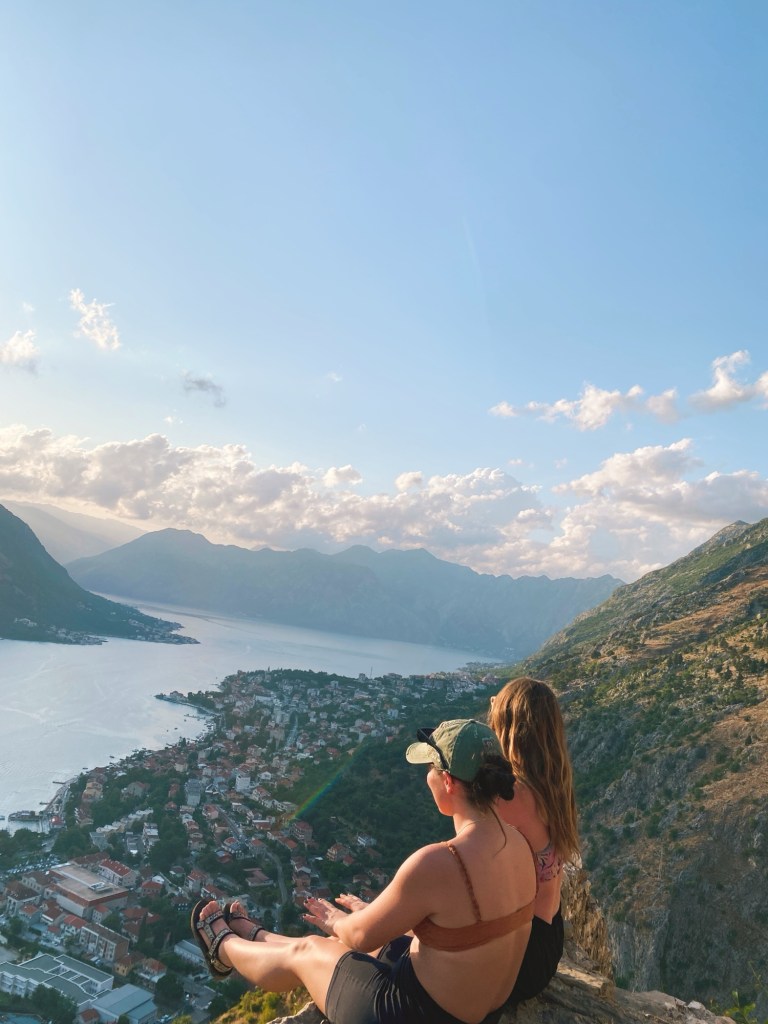
And here I was, flying across Europe. Eating pastel de nata in Portugal, their sweet custard still warm from the oven. Swimming in waters so impossibly clear in Croatia that I could see the sunlight dancing on the seabed. Walking the quiet, glassy shores of Lake Bled in Slovenia. Listening to the haunting, resilient stories of Bosnia & Herzegovina. Watching the sun sink into the Adriatic in Montenegro. Standing on mountain ridges in the Albanian Alps, wind in my hair, heart full of awe.
Every step of that journey was a gift. A privilege. And one that countless people will never experience.
I was, and am, deeply grateful.
I’m learning something important: it’s okay to feel the guilt. It’s okay to acknowledge the frustration. It’s okay to admit when emotions aren’t neat or pretty. Pretending everything is fine doesn’t make me stronger, it makes me disconnected from my own humanity.
But it’s also dangerous to let myself get trapped in those negative currents. I can acknowledge the feelings without letting them pull me under. I can recognize my privilege without drowning in shame. And I can choose, every day, not to take it for granted, the chance to step away, to breathe deeply, to return renewed.
This time away reminded me that rest is a gift, not a given. And the right response to a gift is not guilt, it’s gratitude.
Gratitude that I could go. Gratitude that I could return.
And gratitude that, even in my absence, the work God began continues, because it was never mine to carry alone .
On returning to the ship after what felt like one of the most challenging field services for so many of us, I’ve found myself thinking a lot about processing.
Coming back, I’ve had conversations in passing with friends, over coffee, in the dining room, cozied up in my cabin, where we ask each other: “How was your time away?”“Have you had a chance to process?”“Do you feel ready for the next field service?”
And every time I hear those questions, they linger in my mind.
Have I processed the last field service?
And if so, what does that even look like?
When I look back over my life, I can see clearly that the way I used to “process” things, whether it was a hard day at work, a fight with a friend, the breakdown of a relationship, or a traumatic event, wasn’t really processing at all. It was survival.
I would bury the pain deep inside, packing it down layer by layer, telling myself it was gone. But really, it was still there, alive under the surface, quietly waiting for the moment it would all spill out. And when it did, it often came out sideways, through anger, withdrawal, or habits that dulled the ache without ever healing it.
I had a whole arsenal of unhealthy coping mechanisms: staying endlessly busy so I wouldn’t have to think, running away from my problems, numbing myself with distractions and unhealthy habits, or shutting people out completely. I thought I was protecting myself. But in reality, I was building walls so high that no one, not even me, could see what was happening inside.
And then, I met Jesus.
Everything changed.
Now, I don’t want to paint some glossy picture and pretend that the moment I came into my faith, I suddenly knew exactly how to process pain in a healthy, godly way. That wouldn’t be honest. The truth is, I’m still learning. I’ll always be learning. I still stumble. I still have moments where the old me, the “old Ayla” wants to take back control, to run back to those habits that once made me feel safe but only did damage.
But here’s the difference: I know now that there is another way. A better way.
That way is Jesus.
When I read Matthew 11:28,“Come to me, all you who are weary and burdened, and I will give you rest,” I hear an invitation, not just for those big life burdens, but for the everyday heaviness I carry. It’s an invitation to bring it all, the grief, the confusion, the unanswered questions, right to Him.
Processing with Jesus looks nothing like how I used to do it.
It’s not about numbing, avoiding, or pretending I’m fine. It’s about slowing down long enough to feel what I’m feeling, and then laying it at His feet. It’s about sitting with Him in the quiet, letting His presence be the place where I untangle the knots in my heart.
Sometimes that means opening my Bible and finding words that name my pain and anchor my hope. Sometimes it means writing until my thoughts become prayers on a page. Sometimes it’s walking in silence, letting creation remind me of God’s bigness when my problems feel overwhelming. And sometimes it’s just being still, whispering, “Jesus, I don’t know what to do with this, but I give it to You.”
Another verse that has become a lifeline for me is 1 Peter 5:7— “Cast all your anxiety on Him because He cares for you.”
There is something profoundly freeing in knowing that I don’t have to hold it all. That I was never meant to. That the God who holds the universe is willing to hold me, my heart, my hurt, my processing, without judgment, without rush.
The difference now is that I’m not processing alone.
Before, I thought strength meant independence, that I had to sort through everything in my own mind and on my own terms. Now, I see that strength is dependence, dependence on the One who knows me better than I know myself.
And yes, I still journal. I still write. I still pray. But now, those aren’t just coping mechanisms, they’re communion. They’re sacred spaces where I meet with God, where my processing becomes prayer, where my pain becomes part of my testimony.
I’m learning that processing isn’t about “getting over” something. It’s about letting God walk with me through it. It’s about letting Him speak into the places I’ve tried to silence. It’s about trusting that He can handle the full weight of my heart.
And in that space, I am finding the courage to process. To face what I’ve seen, to feel it fully, and to place it in His hands. The kind of deep, soul-level processing that only He can guide me through.
Isaiah 43:2 “ When you pass through the waters, I will be with you; and when you pass through the rivers, they will not sweep over you.”
Lately God has been inviting me and challenging me to rethink what it really means to be strong. Not the kind of strength that comes from pushing through or holding everything together, but a deeper, quieter strength, one that’s rooted in grace and presence. It’s been a humbling journey, and today, I’d love to share a part of that with you.
There are seasons in life when we feel like we’re barely staying afloat. Maybe it’s the weight of loss, chronic exhaustion, a relationship that’s broken, or the emotional toll of carrying burdens no one else can see. These are the “deep water” moments of life, where strength is needed, but where the kind of strength we’ve always leaned on doesn’t seem to hold up anymore.
In these moments, many of us have internalized a particular version of strength: the kind that pushes through, stays stoic, and never shows weakness. It’s the strength that tells us to be tough, stay busy, and keep smiling. But what happens when that kind of strength runs out?
That question is at the heart of a book I recently read called Strong Like Water by Aundi Kolber, a Christian therapist and trauma-informed writer. She offers a radically different view of strength, one that isn’t about becoming harder or more resistant, but instead about becoming more connected, more compassionate, more attuned to ourselves, others, and to God.
She writes that true strength isn’t brittle. It doesn’t ignore pain or push it aside. Instead, it flows, like water. It adapts. It moves with grace. It yields when needed, but it never loses its power. This idea of being “strong like water” spoke deeply to me because it named something I had already been learning, sometimes painfully, on the front lines of service.
As most of you know I recently started working off ship at a hospital in Freetown, mentoring nurses and walking alongside them through all kinds of clinical and emotional challenges. Some days are full of joy and progress; others feel heavy and heart-wrenching. There are moments when I’ve watched patients die because basic resources aren’t available, or when I’ve seen dedicated nurses pushed beyond their limits. The pressure to perform, support others, and be a source of strength can feel unrelenting.
At first, I did what I’d always done: I pushed through. I told myself I had to be strong. I believed the lie that if I let myself slow down or feel too much, I would fail the people around me. So I worked long hours, put my own needs last, and kept showing up, even when I was emotionally empty.
Eventually, my body and heart began to protest. I could feel myself going numb. Disconnected. Worn thin. The waters were rising, and I knew I couldn’t keep swimming in the same way. That’s when God began to gently invite me into a different kind of strength.
Learning to be “strong like water” meant learning to stay present in hard places, not by fixing everything, but by being with people in their pain. It meant listening more and talking less. It meant grieving when I needed to grieve, resting when I needed to rest, and allowing God to meet me in my limits instead of trying to pretend I didn’t have any.
I began to see strength not as pushing harder, but as allowing grace to carry me. I saw it in the quiet resilience of a nurse who kept showing up even after a night of loss. I saw it in the tear-streaked face of a mother who stayed beside her child’s bed, praying without words. I saw it in myself, in moments when I chose to soften instead of shut down, to keep my heart open, even when it hurt.
Jesus, too, embodied this kind of strength. He wept with the grieving. He stopped to rest. He touched the unclean. He didn’t rush through suffering or avoid discomfort, He entered into it with fierce compassion and a steady peace. His power was never disconnected from love. He was strong like water.
And the promise of Isaiah 43:2 reminds us: we are not alone in the deep waters. God doesn’t say *“if” you pass through the rivers—*He says “when.” The hardship is expected. But so is His presence.
So if you’re walking through something hard right now, or if you’re holding space for others who are, I want to invite you to consider this:
• Could it be that strength isn’t what you thought it was?
• Could it be that God is more interested in your surrender than your performance?
• Could it be that He is offering you the courage to soften rather than harden?
You don’t have to force your way through. You don’t have to prove your worth. God is already with you in the water. And He is not asking you to be invincible, only present, only willing, only surrendered to His grace.
Every day, I find myself trying to hold two truths in tension, joy and sorrow, love and loss, each one vast, vivid, and deeply real. At Connaught, my days are steeped in contrast. I see deep love and deep grief, joy and devastation, celebration and mourning, often all within the same hour. It’s a place where a patient willingly gives up their only medical supplies to help someone else in greater need. Where someone’s mother dies because the medicine she needs is unaffordable. It’s where laughter echoes down a hallway just hours after heartbreak filled the same space.
And somehow, I’ve come to see that these contrasts aren’t separate. They aren’t opposite ends of a scale that I need to balance. They are all part of the same whole. I’m beginning to understand that love and suffering are not two different things, but threads of the same fabric. That joy and sorrow walk hand in hand. That’s something I’m learning deeply through God.
But that doesn’t mean it’s easy. Some days, I come back to the ship with a full heart, bursting with gratitude, for the nurses who tried their hardest, for the patient who pulled through, for the quiet moment of grace in the chaos. And other days, I return hollowed out, angry at the world. Angry at God. I slam my journal shut after scrawling the words, Why God? Why? I ask Him to help me make sense of it all. To show me what good could possibly come from a child dying because they didn’t have a simple antibiotic. I wrestle with the injustice. With the brokenness. With the ache of helplessness.
And yet, even in that questioning, even in the anger and confusion and exhaustion, I’m beginning to know something. I’m learning that God doesn’t ask me to pretend the pain isn’t real. He doesn’t ask me to paste a smile over my grief. He asks me to come to Him with it all. To trust that He is big enough to hold both my joy and my sorrow. Because He feels it too. He feels our joy. And He feels our pain.
In my darkest, most disoriented moments, He is there. When I cry out to Him in anger, He doesn’t turn away, He leans in closer. And when I’m overwhelmed by joy, when I feel love so strong it threatens to split my heart open, I believe He is rejoicing with me.
There is a verse that always finds its way to me, Isaiah 43:2-3:
“When you pass through the waters, I will be with you; and through the rivers, they shall not overwhelm you; when you walk through fire you shall not be burned, and the flame shall not consume you. For I am the Lord your God, the Holy One of Israel, your Savior.”
This is the God I’m learning to trust with all the pieces of my heart, the God who doesn’t promise to shield us from the fire, but who promises to walk through it with us. The God who doesn’t erase pain, but who transforms it into something deeper. More human. More holy.
So I keep walking the line between these emotions; love, pain, joy, suffering, no longer trying to separate them, but allowing them to bleed into one another. Trusting that God is present in all, and that somehow, through Him, they can coexist in grace. Letting the suffering teach me how to love deeper. Letting the joy remind me why it matters. Letting God meet me in both.
Because I’m starting to believe that the most profound transformation doesn’t happen when we escape the hard things, but when we stand in the midst of them and still choose to see beauty, to give thanks, to love wildly.
And in that space, in that sacred, messy, middle ground, I know I am not alone.



 AYLA IN AFRICA